AMF system
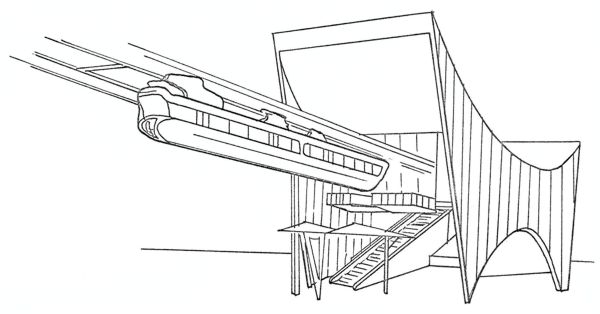
The cars, a joint effort
of Walter Dorwin Teague Associates and AMF design development
engineers for the New York World's Fair, are a step forward,
but hardly a fair test for the actual problems of getting people
to and from places of business and pleasure.
|

A perspective
cut-a-way rendering of the SAFEGE monorail vehicle with its four-wheeled
"bogie" exposed. Four additional horizontally oriented
smaller wheels act to guide the truck along the track web. Two
of these smaller wheels, diagonally opposed, are fixed in place,
while the other two are spring loaded to compensate for variations
in the track web. All eight "bogie" tires are rubber
cushioned.
|
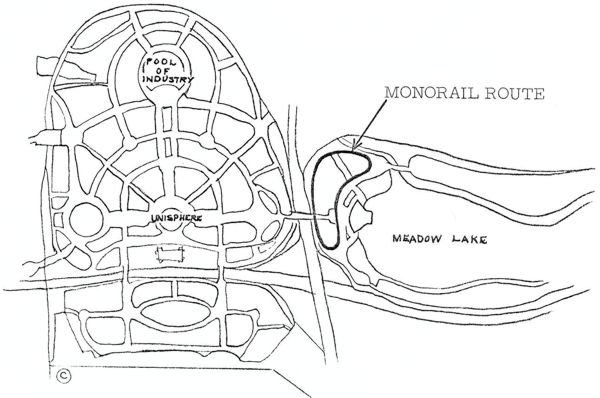
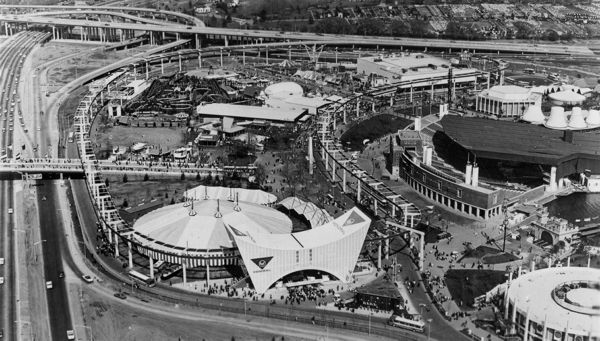
The existing train, consisting
of coupled cars 90 feet long, rides 40 feet above the ground
on two parallel 4000-foot loops and is moved by "bogies"
developed by the General Electric Company. The system is not
a new one, since both its forerunners and the present system
are the product of long term development by SAFEGE (Societe Anonyme
Francoise de Gestion et d'Enterprises). This giant French combine
has as its various ingredients Renault, Michelin Rubber, French
banks, construction companies and metal fabricators. Lucien F.
Chadenson, chairman and president of SAFEGE-Transport, developed
his boxed-beam principle, and subsequently built a mile long
test track at Chateauneuf-sur-Loire. During the past two years,
a SAFEGE car has been operating on this track at speeds up to
90 mph while running almost daily. The advantages of a box beam
are simply that it keeps out the weather, giving uninterrupted
transportation service, leading also to safety conditions which
are reinforced by both a fail-safe method of switching and a
fail-safe supporting system.
Simplified elevation diagram illustrates
a dual track and pier. Each of the two tracks suspend the car
by "primary link, pin connected to the car fitting at its
lower end and a ball swivel anchors to the track at its upper
end. The ball swivel pin is captive in a steel casting, which
is guided in the track frame and supported by four air springs."
 |
AMF has been granted a
franchise to construct prototypes and working trains in the United
States for SAFEGE. The World's Fair train is an example of the
cooperation of this alliance. As it exists at the Fair, it is
automatically controlled, governing train arrivals, departures,
door opening and closing. In keeping with the ground rules for
speed, the World's Fair train travels at only 9 miles an hour,
and, although this is not a test of the system, the Fair installation
does demonstrate the following: that it can exist in airspace
over congested areas; that its narrow support beams do not greatly
interfere with traffic or structures below (which may mean a
good deal when considering the expense of purchase and taxation
on right-of-way); that it can manage turns in a short space (it
can potentially round 1/4 mile radius curves at 70 mph); that
the system is relatively noiseless, and not subject to appreciable
sway (anti-sway devices, whether needed or not, have been installed
in the prototype system); that the trains are capable of exceptional
deceleration, which is a must ingredient of any system operating
over short runs; and that a considerable price saving can be
achieved in the choice of 1.5 million per mile monorail cost
over 7.5 million per mile subway cost.
AMF/SAFEGE fail-safe track switch.
Upper picture depicts straight-away position, lower picture, turned-out
position. Switch unlocks, rotates, and relocks in the same manner
as standard high-speed railway switches.
 |
Passenger cars
Each individual car, as
constructed for the Fair, measured 45 feet over-all as coupled,
9'6" in height, and 8'3" in width. Capacity of a single
car rests at 40, with the orientation back to back along a central
axis. In the event of future installations for higher speeds,
seating would probably be oriented at right angles to the direction
of travel with an attendant for each train, who has over-ride
controls to be used in case of emergency or by maintenance personnel.
Inside car view looking
forward in the AMF installation at the New York World's Fair.
Notice that the seats are back to back, slightly tilted and ribbed
for comfort. Car walls also angle in toward the floor. We noticed
on a test ride of the vehicle that visibility was excellent from
any vantage point, and that passengers were not particularly aware
of overhead suspension. Entrance and egress seemed appropriately
efficient when dealing with a full load of passengers.
 |
The general appearance
of the car is reminiscent of the old trolley car. The similarity
stops at the surface, however. The design and construction of
the present cars are to a certain extent the product of very
short-run production, requiring much lay-up by hand and a spectacular
362-day design and construction program, since the Teague office
did not start the project before April, 1963. According to Milton
Immermann, director of the WDTA design team for the World's Fair
Monorail project which included partner Robert H. Ensign and
associate Danforth Cardozo, the reinforced plastic would be used
more extensively in a full-production model. As it is, the front
and back windows are tinted acrylic, the front of the car is
reinforced plastics, window surrounds are vacuum-formed ABS plastics,
the bogies' shroud is again reinforced plastics and, finally,
the seats are constructed of reinforced plastics with vinyl upholstery.
The side body paneling of the present model is of steel sheet,
but in the full production model this could very well be reinforced
plastic. Strength in the event of accident does not depend on
the thin-skinned outer shell, but on a steel skeleton, one of
whose beams can be seen in in the above picture at the end of
the interior. Standard procedures and materials were used throughout
to assure speed of construction. Any further systems would be
redesigned to fit specific problems.
Any city contemplating
the installation of an AMF Monorail could design the system around
some rather exciting aspects. The cars can climb at 10% grade.
The system is attachable to existing bridges without a great
deal of new superstructure and the trains could be run either
above ground or on ground level or in a tunnel. Serious consideration
is being given to the AMF Monorail by several U.S. cities. The
Wall Street Journal reports that the company expects one
firm order before the close of the year. Among the cities interested
are Newark, Los Angeles, Washington, Kansas City, Chicago, Sacramento,
Long Beach, Las Vegas, Palm Springs, and Atlantic City. It will
not be decided, until someone takes a crack at it, whether monorail
travel does or does not do the job that its several backers claim.
|