|
BUILDING THE AMF MONORAIL
|


- A BLUE PRINT
FOR PROGRESS
-
- From
drawing board to fully automated operation in 342 days - that's
the story of the AMF Monorail as it circles the lake amusement
area at the New York World's Fair 1964-1965.
-
- A design and engineering team
managed by American Machine & Foundry Company, and supported
by Sverdrup and Parcel, Architects and Engineers of St. Louis,
Missouri, Walter Dorwin Teague Associates, Industrial Designers
of New York, and the St. Louis Car Company of St. Louis, Missouri
began work on design of the AMF Monorail system on 15 May 1963.
Working concurrently, this group expedited design and engineering
on cars, bogies, station superstructure and track so that fabrication
and construction could begin in early August 1963.
-
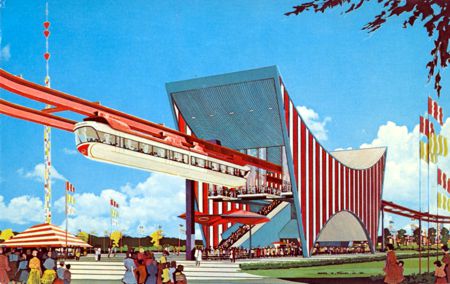
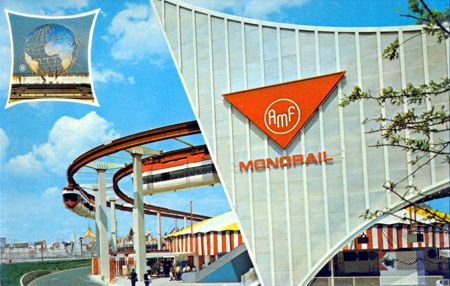
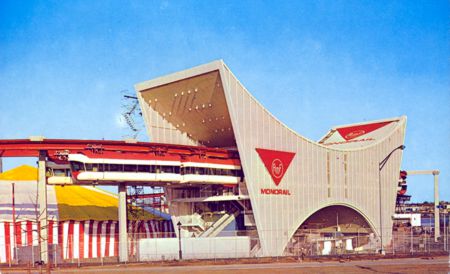
- The AMF passenger station of
contemporary design, with an inverted arch roof, is the outstanding
landmark of the amusement area. It is 166 feet long, 52 feet
wide, and rises to a height of 80 feet at either end. High speed
escalators will expedite movement of passengers to and from the
40 foot high platform area.
-
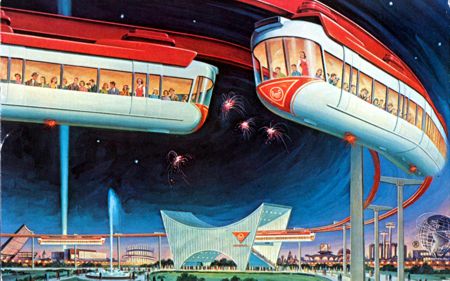
- A forerunner in a family of
Monorail systems for the mass transportation field, the AMF Monorail
will afford its passengers a ride as smooth and quiet as a silent
rush of air. Seven two-car trains, three on one loop going clockwise
and four on the other moving counter-clockwise, will operate
continuously over the 4,000 foot closed loop track suspended
40 feet in the air. With a peak capacity of 4,800 per hour, it
is estimated that 15 million passengers will ride these seven
air conditioned trains, embodying AMF designed fail-safe devices,
during the two seasons of the Fair. Although rapid transit monorails
will normally operate at high speeds, the World's Fair system
has been held to a moderate rate of speed to give riders a panoramic
view of the spectacular World's Fair scene and a good vantage
point for photography.
|
|

 |
- Early in April 1963, the vacant Lake Amusement Area
in flushing Meadow park, last occupied during the 1939-1940 World's
Fair, was surveyed for locations of the AMF Monorail around its
perimeter. Ground was broken shortly thereafter, and by mid-July,
construction work was well under way. 48,000 lineal feet of pilings
and 1,400 cubic yards of concrete were required for column footings
and station foundation. The first 50 foot column was lifted into
place on December 2, 1963. The last of 68 columns was bolted
into position on January 3, 1964. William L. Crow Construction
Company of New York was general contractor for the project. Prefabricated
steel was furnished by Harris Structural Steel Company.
|

 |
- On December 3, 1963, the first 50 foot section of
prefabricated, double webbed I-Beam was readied for elevation
into its pre-determined position in the track. On January 27,
1964 the last section of the 4,000 foot track was hoisted into
place to close the loop. The passenger station had begun to take
shape in December, 1963 and in February, 1964 was already the
most outstanding structure visible from the adjacent intersection
of Long Island Expressway and Grand Central Parkway. By early
April, 1964 the station was in final stages of completion and
available as the platform for checkout of the automatic block
signal control system.
|

 |
- The AMF Monorail, encircling the Lake
Amusement Area, lies to the east of the Long Island Expressway,
between the Grand Central Parkway and the Van Wyck Expressway,
across from the main exhibit area of the Fair. Parking lots can
be reached directly from these three thoroughfares. The Meadow
Lake Bridge connecting the amusement area and the exhibit area
can be seen on the left. The aerial photograph shows the completed
track and the partially finished passenger station as they appeared
on February 15, 1964. The Texas Pavilion is the square building
inside the outer loop of the Monorail track at the upper right.
The circular structure just behind the station is the Continental
Circus. The Hawaii exhibit, the Amphitheatre and the Florida
building can be seen outside the Monorail track from top to bottom
on the right.
|

 |
- Concurrent with the design and engineering of foundation
and superstructure, work was begun in early May, 1963 by AMF's
General Engineering Division on design, fabrication and test
of the 28 rubber tired "bogies" or trucks, which propel
the suspended two-car trains along the track. Static and dynamic
tests were conducted in AMF laboratories and on a specially constructed
test track where actual load and operating conditions were simulated.
Robert Moses, President of the World's Fair Corporation and other
Fair officials visited the test track area and rode the test
car with Carter Burgess, AMF Chairman, on December 5, 1963.
-
- During the same time period,
Walter Dorwin Teague Associates and St. Louis Car Company proceeded
with design and fabrication of the 14 cars that make up the seven
trains. Fabrication of the first car began on November 6, 1963
and was completed on February 7, 1964.
|

 |
- On February 10, 1964 the first car arrived on the
site and was elevated to its suspended position on the track.
The on-site checkout program began immediately and increased
in tempo as additional cars arrived at the rate of two per week.
The last two car train was activated on April 3, 1964
-
- The colorful costume for "Miss Monorail"
and other train hostesses was created by fashion designer Anne
Fogarty, using the all-new DuPont "Acrobat" Lycra stretch
poplin fabric. The distinctive hostess hat, which is patterned
after the upswept architectural lines of the Monorail station,
was created by Miss Mary of New York. Claire Lange Associates,
Fashion Consultants of New York, collaborated on design of the
hostess costume and hat. the uniform for male passenger control
attendants was designed by Walter Dorwin Teague Associates of
New York.
|
 |
- THE SAFEGE
MONORAIL
-
- The SAFEGE Transport high-speed monorail
system was developed by Lucien F. Chadenson, world famous bridge
builder, Chairman and President of SAFEGE Transport. It is a
high speed system of advanced design and is operating on a one
mile track at Chateauneuf-sur-Loire, 90 miles south of Paris.
The car is suspended from rubber-tired power units or bogies,
which run on tracks enclosed within a box beam structure. This
exclusive patented feature provides protection against snow and
ice, assuring safe and uninterrupted operation of the system
in all weather. AMF has acquired a license to market the SAFEGE
Monorails system in the Untied States.
|
 |
- The increasing need for modern, rapid mass transportation
is one of the most pressing problems facing the nation today.
By 1985, more than half of our expanding population can expect
to live in some 40 great urban complexes. The problem of mass
transportation which is pressing today, will be acute tomorrow.
AMF believes its Monorail systems are the key to solving many
of the problems facing traffic congested cities in the years
ahead. Discussions have been held with a number of cities to
show the advantages of high-speed monorails for airport-city
center transportation.
|
Source:
Booklet AMF Monorail Tomorrow's TransporationToday presented
courtesy Randly Lambertus Collection
 |
Source:
Men at Work 1964-65 World's Fair by Luciano Guaruiori presented
courtesy Randly Lambertus Collection
 |
Construction Photos of the
AMF Monorail Terminal
|
Source:
Presented courtesy Randly Lambertus Collection
|
|