-
THE BELL TELEPHONE
SYSTEM EXHIBIT BUILDING
-
AT THE NEW YORK
WORLD'S FAIR
|
|
|
| A Colossal "Floating
Wing"
|
 |
|
|
|
|
|

A typical truss
vertical shown at Bethlehem's Pottsdown Fabricating Works illustrates
some of the complexities of the structure. All of the vertices
were built up of steel plate, with precisely skewed web plates.
Note the extreme thickness of these plates.

An early stage
of steel erection. Virtually all field connections were welded
and radiographed.

Cutaway sketch
of the structure at its midpoint shows how the ride passes through
the "long" U-frames; mechanical equipment is housed
in the "short" U-frames.
|
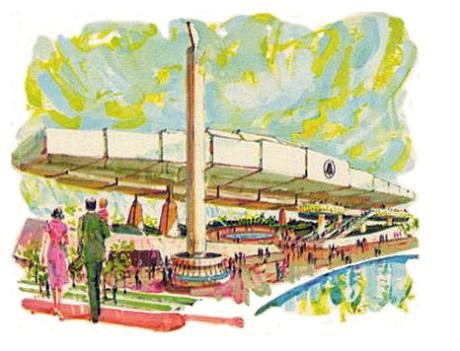
This structure would be notable
if it were just a fraction of its actual size; in fact, it is
400 ft long, and 200 ft wide at its longitudinal midpoint, where
it is about 60 ft deep. It spans 180 ft between supports, and
cantilevers 108 ft beyond them. Also, along the entire 400-ft
length of the structure, it cantilevers from the trusses as much
as 66 ft toward the front, and 38 ft toward the rear.
This vast volume is supported
on just four steel piers, two of which are designed for a load
of 4,200 kips each, and the other two for a load of 2,500 kips
each!
These supports, each 35 ft high
from bottom of base plate at grade to center of bearings, rise
through a base structure structure which occupies virtually the
full 105,000-sq-ft site. This structure, which contains exhibits,
offices, VIP reception rooms, etc., is not described here. We
shall confine our description to the "wing", which
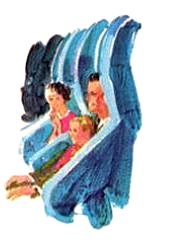
houses a chair ride which transports visitors through a series
of theaters.
THE "WING"
FRAMING
Basically, the wing's framing
relies on a dual backbone of two trusses which extend the entire
length supported by the four pylons, and forming a pointed ellipse.
The trusses very in depth from 15 ft 7 in. at each end to 42
ft at the midpoint. Members were fabricated by shop welding,
erected piece-by-piece, and field-welded. Although the trusses
curve in plan, each of the eleven 36-ft panels is straight; all
curvature is provided by skewing the flanges and connection plates
of the verticals.
|
|
The transverse frames at the
extreme ends were erected after all U-frames were in place. The
completed structure gives no outward hint of the pointed effect
so evident in this picture.
|
|
Transverse ridge bents connect
the two trusses, spanning 38 ft c-c of truss verticals near the
ends of the wing, up to 94 1/2 feet at the longitudinal midpoint.
The three end bents are of welded-plate design; the rest are
trussed.
To achieve the cantilevers along
the front and rear of the wing, U-frames are connected to the
truss verticals at each panel point. These frames are shop-welded,
using reinforced 36-in. wide-flange shapes. All but those at
the ends (and the bottom members at the pylons) are pin-connected
to the truss verticals.
Tension ties extending from the
"front" truss U-frame connection points diagonally
down to the lower members of the transverse bents, help take
the "kick" from the U-frames. They are made up of two
18-in., 58-lb channels, back-to-back, with spacer plates.
Lateral Secondary
Framing. It should be
noted that there are no floors, per se, in the wing. Its huge
volume is occupied by the ride and its framing members, a series
of theaters, a projection booth, the mechanical equipment, and
necessary catwalks and platforms for access. There is, therefore,
no conventional floor framing, nor the added rigidity ordinarily
furnished by a floor system.
The primary lateral members between
transverse frames are beams of various sizes, welded in place.
Generally speaking, the exterior shape of the wing is established
by L series open-web joists, equipped with outriggers, which
establish the architectural overhang at each bent line.
A major problem in fabrication
and erection was the requirement that all external steel members
adhere to a trace line with an accuracy of +-1/16 in., to assure
absolute smoothness of the skin.
Supporting
Columns. Although given
an architectural finish that disguises their structure, the wing's
supports are structural steel. The trussed pylons, used at the
front of the wing, 14 WF 228 legs. The one shown at the [right]
measures 30 ft 8 1/2 in. from top of base plate to bottom of
bearing shoe.
|

The heavy diagonal
members shown here help transmit the "kick" from the
long U-frames.

One of the two
front, trussed pylons. It is the only support equipped with rollers
to permit slight movement, horizontally on the "wing's"
longitudinal axis.
Architect: Harrison & Ambramovitz; Exhibit
Design: Harrison & Ambramovitz; Consultant: Henry
Dreyfuss; Producer-Designer, Ride: Joel Mielziner; Structural
Engineer: Paul Weidlinger; Mechanical and Electrical Engineer:
Syska & Hennessy, Inc.; General Contracter: George
A. Fuller Company; Steelwork: Bethelehm Steel Company
|
|
Whereas all other bearings are
fixed, this one has rollers which permit slight horizontal movement
to compensate expansion and contraction due to temperature changes.
All bearing shoes are massive, measuring 7 ft 6 in. by 7 ft 2
in. in plan.
The two rear pylons are free-standing
clusters of four 14 WF 184 columns, groove-welded to plates top
and bottom. They are not braced and permit slight bending.
Ride Framing.
The chair ride, which
will take 4,000 visitors an hour on a 1,000-ft-ride lasting twelve
minutes, required a rather complex framing system. It not only
follows an irregular path in plan, but it has two lanes, one
higher than the other, as well as a number of changes of elevation.
The main carrying beams are 18
WF 96 sections, with 6 B 15.5 filler beams. Along the front of
the wing, within the U-frames, the ride rests on 18 WF beams
connected to the upper flanges of the lower members of the U-frames.
Elsewhere, however, the entire ride is elevated on columns.
|
|
|
|
| Source: "World's Fair
Preview" -- Bethlehem Steel Co. (Courtesy of Tom Wentland) |
|
| View of Bell System
Pavilion from the Pool of Industry

|
Source: Commercial Transparency by Photo Lab, Inc., Washington, DC(Courtesy of Bradd Schiffman)
|
|
|