wonderful world of CHEMISTRY

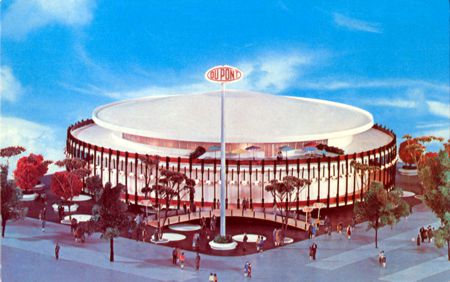
Huge circular pavilion which houses Du Pont's exhibit.
DuPont Pavilion
 
 
films are blended into lively stage shows
in two theaters of Du Pont's circular pavilion

Fairgoers wait on the colonnaded "porch" of the Du Pont Pavilion for their turn to see "The Wonderful World of Chemistry" musical revue.

Waiting on Line for DuPont Show


THE DU PONT PAVILION SHOW, "Wonderful World of Chemistry" is a musical revue in which singers and dancers onstage join in musical interplay with other performers on motion picture film.

It's startling fare, which requires perfect timing, especially when a girl on film passes a rose to a boy onstage, who in turn, hands it to another girl on film.

Three circular theaters uphold a N.Y. Fair tradition. In the Blue and Gold Rooms, audiences are viewing the same musical shows; then they move to a dazzling Red Room for science demonstrations.

Michael Brown wrote, produced and directed "Wonderful World," using an Elliott, Unger and Elliott film production. Animation was by Ernest Pintoff; special effects where by Film Effects of Hollywood. Bob Hills was show consultant. Scientific concepts and design of the Red Room show were by Jonathan Karas, with a spectacular finale in Mobilcolor.

Source: BUSINESS SCREEN MAGAZINE Presented courtesy Eric Paddon Collection

Girls on screens and boys onstage perform the flower-passing sequence.

Flower-passing Sequence

In this animated film sequence, audiences learn that all Greek philosophers did was just sit around and think; other film sequences continue the interplay between live talent onstage, events on screen..

Animated Film

Sketch of the Du Pont circular theater arrangement (all elements are stationary). Both Blue and Gold Rooms offer same musical show.

Pavilion Map
   

BACKSTAGE AT THE FAIR By HARRY E. DAVIS
Products and performers are taking their places as Du Pont nears the premier of its
"Wonderful World of Chemistry"

Artist's Rendering of DuPont Pavilion 
Source: DuPont Magazine, March-April, 1964, Volume 58, No. 2e &COP Copyright 1964, E.I. DuPont de Nemours and
Company, Wilmington, DE

Come Wednesday, April 22, the evening sky over this theatrical mecca will glow with a light visible for 200 miles. Equal to 340,000 auto head lamps, the powerful spotlight will open the most heroic variety show ever staged, the 1964-65 New York World's Fair.

A billion-dollar spectacular, the Fair will star a cast of thousands in a 650-acre setting. its colorful account of the world's ideas, customs and achievements will run from mid-April to mid-October, both this year and next, playing to a total of 70 millions visitors.

Imaginative architects and builders have speedily transformed Flushing Meadows Park into a dazzling city of soaring arches, cantilevered beams and gleaming glass -- in all, 150 exhibitor pavilions encircling the symbolic Unisphere, a 13-story, 250-ton stainless steel globe.

As showtime nears, spirited dancers gyrate to the rhythms of the limbo, flamenco and calypso in the quaint pavilions built for 50 foreign exhibitors.

Being readied are a geisha house, temples and pagodas and collections of jewels and art from all corners of the world. Most foreign pavilions, too, will include restaurants serving native food and drink.

Elsewhere under the Unisphere, major states, New York City and the Federal Government are painting a 20-pavilion panorama of America. Sights will range from Indian to hula dancing, from old-time trains to space vehicles and modes of futuristic cities. States will likewise point with pride to reproductions of a lavish movie set, the aurora borealis and famous national landmarks.

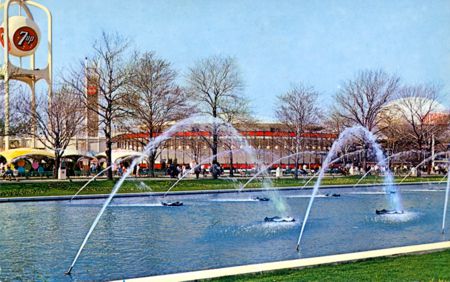
American industry will be the largest exposition group, accounting for more than 200 of the Fair's 300-plus exhibitors. The firms' diverse displays, from a demonstration of atomic fusion to a candy factory, are being assembled in 35 giant showcases. These pavilions ring a huge reflecting pool, site of nightly music, colored fountains and dazzling fireworks.

Amid this industrial montage is the Du Pont Pavilion, a two-story, carousel-like building 180 feet in diameter.

Du Pont's show theme will be the "Wonderful World of Chemistry." Entertaining songs and dances blended with startling demonstrations will portray the chemical industry's origin, progress and contributions to mankind.

Currently, seven casts are rehearsing the variety segment, which will be presented more than 10,000 times in two 300-seat theaters. The casts rate as unusual, for they include six choreographed movie screens.

Wheeling freely over the theater stages, the screens will project humorous characters who sing and dance with live performers. Demanding perfect synchronization of images and actors, this interplay leads to such surprises as a screen character mystifyingly handing a bag of groceries to a live actress. In another scene, an actress hosing down an auto projected on one screen somehow douses a figure on another screen across the stage.

The lighthearted show is built around an original score written by director Michael Brown, who has penned music and lyrics for many successful Broadway and supper club performances.

Show director Michael Brown and assistants consider last-minute revisions in musical score.
Michael Brown and Assistants

Brown's whimsical short course on chemistry's evolution begins with the ancient Greeks. They're depicted as furiously pondering the earth's makeup but never testing their ideas.

By contrast, frustrated alchemists seek to turn lead into gold by experimenting wildly and with little regard for logic. Du Pont's alchemist fares better than his Middle Ages contemporaries: his muddy potion congeals into peanut brittle.

The chaos of the past ultimately becomes chemistry with France's Lavoisier, who identifies the earth's basic elements and the formula for water. He also takes on a bright, young apprentice named E. I. du Pont, who later emigrated to America and founded a company dedicated to both thinking and testing.

Better Things are Born

Brown chronicles the results of Du Pont Company research in amusing skits. There's Grocer Goodfellow who tries delicately to shoo flies from food in a 1915 general store. His worries end when Du Pont introduces moisture proof cellophane, which in turn helped to usher in the supermarket with its attractively packaged and protected foods.

In another scene, a madcap musical trio of women salutes "Freon" propellants, which gave birth to the aerosol industry. Working push buttons on spray cans topped with whistles, the women swing into an off-key tune. Whereupon one spray can rebels, covering its handler with a foamy lather. The woman's distraught look turns to pure pleasure, though, when she licks her lips and discovers "Butterscotch!"

At the 1939-40 World's Fair, Du Pont announced nylon. This year the company will unveil another exciting contribution to fashion: "Corfam" poromeric upper material for footwear.

Fashion in apparel will share the spotlight. Predictions of styles to come this summer and next year will be made by four noted designers, Donald Brooks of Townley, Oleg Cassini, David Kidd of Arthur Jablow, and Ceil Chapman. Clothing will capitalize on the properties of DuPont fibers: nylon, "Orlon" acrylic, "Dacron" polyester, "Lycra" spadex and "Antron" nylon.

Audiences will end their DuPont visit in a product arena where demonstrators will present a fast-moving show of "chemical magic." One example of the surprises planned will be a plain piece of fabric which, dipped into a solution, emerges as an American flag. The trick lies in Du Pont selective dyes applied to the cloth beforehand and activated by the solution.

In a demonstration of heat resistance, a narrator will walk about a stage carrying a red-hot rivet. Visitors will discover that his hand is shielded by a paper-thin sheet of "Tipersul" fibrous potassium titanate.

In addition, the company has lined up an elegant white mink coat to register another product's advantage: the non drip property of "Lucite" wall paint. The coat will serve as a drop cloth while a demonstrator standing over it confidently splatters dark blue paint on a wooden panel.

Several major products will also feature prominently outside Du Pont's own building. For example, 14 room settings in the Pavilion of American Interiors will feature carpets of Du Pont 501 nylon, plus upholstery, draperies and furniture cushions of "Dacron."

The House of Good Taste, an exhibit of outstanding architecture and decor, will include upholstery and wall covering products of the du Pont Fabrics and Finishes Dept. Du Pont paint will also protect the exhibits' house of tomorrow.

Lending added excitement to the Fair will be an array of amusements including a lavish ice show, a 90-minute review of American musical comedy and "Les Poupees de Paris," an hour-long puppet show.

Rides will abound. Among them will be "shooting the rapids" in a hollow log, a monorail and a simulated helicopter that rises 100 feet. The entire World's Fair will be seen from the Swiss Sky Ride, gondola cars swinging on cables 112 feet overhead.

Although riders will look down on a spectacle lasting only two years, they will leave with a permanent legacy: better understanding among peoples of the world.

David Carter, a Brown aide, puts members of Du Pont cast through an original dance step.
David Carter and Dancers 

Source: DuPont Pavilion brochure
VISIT DU PONT AT THE
NEW YORK WORLD'S FAIR 1964-1965
The Fair of all fairs - 646 acres of wonder and thrills
. . . nearly 200 exhibit buildings . . . 75 restaurants
featuring many national cuisines . . . rides,
stage shows, movies, fireworks . . .
 
. . . and right in the midst of it all, occupying a
prominent position at the Fountain of the Planets . . .
 
THE DU PONT PAVILION
Of striking carousel design incorporating 48 Du Pont
products in its construction and appointments,
the Pavilion contains two theaters and a
demonstration arena for presenting
 
"WONDERFUL WORLD OF CHEMISTRY"
. . . a theatrical production synchronizing actors on
stage with actors on film, followed by dramatic
chemical demonstrations - the entire 45-minute
show spot-lighting significant products of Du Pont
research. The performances are scheduled
continuously throughout each day, admission free
to the millions of persons attending the Fair.
DuPont Pavilion Model

THE DU PONT PAVILION
NEW YORK WORLD'S FAIR 1964-1965
"WONDERFUL WORLD OF CHEMISTRY"

In two theaters and a large display area, live actors and actresses, motion pictures and demonstrators will present the newest contributions made by chemical science to "Better Things for Better Living . . . through Chemistry."

DuPont Postcard

Source: Official Postcard by Dexter Press, West Nyack, NY


More Content