GROUNDBREAKING AT THE

NEW YORK WORLD'S FAIR 1964-1965

Groundbreaking Photo

Due to a last minute downpour, symbolic groundbreaking ceremonies, complete with toy shovels, were held for Eastman Kodak's Fair exhibit. Left to right: William A. Berns, Fair vice president for Communications and Public Relations, Robert Moses, Fair president, and William S. Vaughn, president of Eastman Kodak.


REMARKS BY WILIAM S. VAUGHN, PRESIDENT OF EASTMAN KODAK AT THE EASTMAN KODAK GROUNDBREAKING CEREMONIES, NEW YORK WORLD'S FAIR, TUESDAY, AUGUST 21, 1962.

MR. VAUGHN: Mr. Moses, members of the press, distinguished guests and visitors:

It is indeed a pleasure to be here with you this morning -- much more so if we were outside, I might add. Your presence adds support and validity to our own belief that this exposition has true significance for industry, for our company, to this community and our state, and to the nation.

We're confident, further, that its appeal will be truly international.

On this occasion we mark the beginning of our contribution to that appeal. On these grounds, nearby, are the foundations for the pavilion symbolic of photography's remarkable achievements over 140 years.

At its outset photography was a promising but cumbersome practice, something between art and alchemy. Later, as it became less difficult for the user and more manageable in the laboratory, photography and its influence began to grow. Today it is the world's leading hobby. Its sphere has extended to education, industry, commerce, government, medicine and the sciences. It is one of the most versatile tools in the service of mankind.

In the finished pavilion on the Kodak site, visitors will find the most complete and colorful exhibit ever assembled to display photography's impact on our lives. We are confident that it will bring new awareness of photography's pervasive scope and influence.

Part of the scope to which we refer is the enjoyment that millions associate with photography as a leisure activity. But there is more: The historian's interest in what went before preserved on film; photography's ability to measure and document progress; industry's growing use of photography as an ingenious and trustworthy production tool. The Kodak exhibit will present these and many other areas of interest.

Accomplishments of the past will be on display. We will not neglect those pioneers who gave photography its start: Niepce and Daguerre, Talbot and Archer were Europeans but it was an American, George Eastman, who pioneered roll film and the simple hand-held camera that made picture-taking both popular and practical for millions.

We intend to offer Fairgoers an exhibit as appealing, as instructive, and we believe even more dramatic than those which have previously appeared under the Kodak emblem. Exhibits will be designed with doing as well as seeing in mind. We also intend to present visual impressions that only photography can capture and convey -- impressions too fleeting for the unaided eye to recall and interpret.

In physical design, the Kodak pavilion is the result of many months of thought and effort. Those chiefly responsible, the Company's architects and designers -- Will Burtin and others in his organization -- have worked diligently and imaginatively and to excellent purpose.

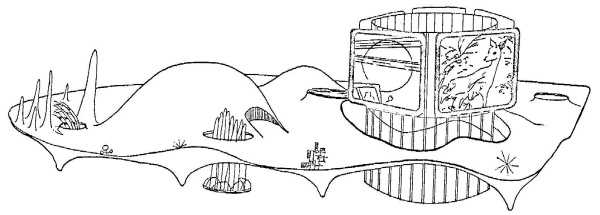
We are pleased at this time, as you see here, to show you the design of the pavilion as it will appear. We believe that this pavilion will be regarded as a unique architectural showcase.

A floating carpet of concrete, supported by four main columns, will provide a surface of gently sloping walkways, gardens and fountains. There will be attractive settings for camera users who wish to photograph their families and friends.

Beneath the concrete carpet, at ground level, the visitor will find numerous exhibit areas of interest. Here, he will be able to pass at leisure through the world of photography and also view exhibits which recall Kodak achievements in other fields, such as chemicals, plastics, and synthetic fibers.

A large and striking tower of photography will add visual drama. The equivalent of an eight-story building in height, the tower will have around its shaft five giant photographs. We expect that each of these will be more than 2,000 square feet in size and, illuminated by day and by night, will be visible from afar as well as nearby. The tower will also house a large theater capable of accommodating thousands during the course of each day's Fairgoing hours. We are at the present time planning a 12 to 14-minute motion picture for showing. For this production and for all that will appear at our exhibit, we will draw upon our years of technical experience and results of continuing research.

Extensive study has gone into new methods of photographic display. Our aim is a total presentation, as exciting in technique as in topical matter. We've already referred to the part played by photography in modern life -- in business, in science, in health, and in a variety of fields.

We believe that no other medium is more admirably suited to carry out the purpose of the New York World's Fair -- Peace Through Understanding.

By 1964, the industrious and imaginative efforts of Mr. Moses and his associates will have come to fruition. Flushing Meadow will have been transformed by then into a symbol of human achievement. We are pleased to mark at this time the beginning of Kodak's part in this challenging enterprise.

We appreciate your willingness to share this occasion with us. But let me add this invitation: Won't you come again and see us at the Fair? Thank you very much.

Scale model of the Eastman Kodak Company building for the 1964-65 New York World's Fair shows the 80-foot tower ringed by five giant photo enlargements that will be illuminated day and night. One of the 10 largest Fair buildings to be built by American manufacturing companies, the structure will contain two theaters, 26 exhibit sections and -- on the open-to-the-skies level -- numerous backdrops where visitors can take attractive pictures.

Kodak Model

SOURCE: Eastman Kodak Press Release - Courtesy Gary Holmes Collection

Letterhead  For Immediate Release

KODAK PAVILION TO BE MAJOR WORLD'S FAIR ATTRACTION

The most fascinating story ever told about photography and its impact on our everyday lives has been promised visitors to the Kodak Pavilion at the New York World's Fair.

Now nearing completion, the Kodak Pavilion will be one of the ten largest industrial exhibits at the Fair. The two-level, uniquely designed structure will house over 15 separate show areas that will dramatize the vital role the camera's "searching eye" plays in science, medicine, industry, commerce, education, communications, history recording, outer space exploration, and leisure-time activities.

The exhibit will provide attractive and restful areas where fairgoers can relax, take pictures against exotic backdrops including a panoramic view of the Fair itself, discuss photography with experts and view collections of some of the world's finest photographs.

According to Lincoln V. Burrows, Kodak's director of World's Fair Planning, the exhibit will be an attraction not only for camera enthusiasts but for people of all ages and from all walks of life.

"Our pavilion will be a place where people will be able to do exciting things as well as see them," he said.

Many of the exhibits will incorporate audience-participation devices that will enable visitors to select photographic subjects of their choice for viewing, and practice new techniques to improve picture-taking skills.

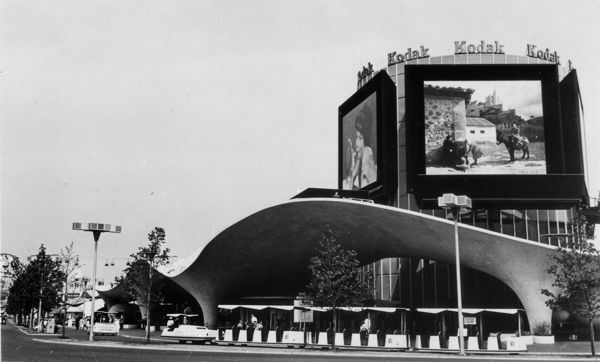
One of the most spectacular features will be a giant, circular Picture Tower rising eight stories above the Fair grounds. Around the tower will be five huge outdoor color prints -- the world's largest. Each measuring 30 feet x 36 feet, they will be front-illuminate day and night by a specially-developed lighting system. The pictures, taken by crews of Kodak photographers in most countries of the Free World, will be changed every four weeks. Because the Picture Tower will be visible for miles around, it is expected to become a favorite rendezvous spot for Fair visitors.

A feature attraction at the Kodak Pavilion will be a major film production, "The Searching Eye" by Saul Bass, noted Hollywood graphics designer. Through dramatic applications of color photography and new multi-image, 70mm projection techniques, common-place and unusual wonders of the world will be presented as seen through the eyes and imagination of a 10 year-old boy. The continuous show will take place in a circular, air-conditioned theater capable of accommodating 35,000 people daily.

Of special interest to camera-carrying visitors will be the glass-enclosed, air-conditioned Information Center, staffed by Kodak technicians who will answer questions concerning photography. Helpful literature on how to photograph the Fair will be available and information will be posted announcing the photogenic events of the day around the Fair grounds. Kodak products will be on display and there will even be a darkroom where minor camera adjustments and repairs can be made for the public by the pavilion staff.

Multi-lingual attendants will be on duty in the International area to assist foreign visitors. The Salon area will feature prize-winning press, professional and amateur color photographs from all over the world.

A working model of the Tiros weather satellite will show how space photography is used in weather forecasting, and an animated model of a spaceman will demonstrate a library of the future on microfilm using a microfilm viewer -- all confined in his space capsule compartment.

Informative exhibits of photography in the graphic arts, news photography and the motion picture industry will be displayed. Newsworthy events at the Fair will be photographed and projected in the Kodak exhibit almost as they occur.

X-rays and their application to the physical well-being of man and his machines, their use in crime detection and other uses will be dramatized. Special exhibits will be devoted to expanding the picture-taking horizons of the amateur photographer.

Mr. Burrows estimates that it will take a visitor bout four hours to see the complete Kodak exhibition. A number of attractions will be change from time to time as the Fair progresses.

#

12/63


Wooden flooring makes up the "moondeck" of the Kodak Pavilion.
 
SOURCE: NY World's Fair Progress Report No. 8
April 22, 1963
Kodak decking
Steel framework of the pavilion which has not been covered with the wooden "skin." Kodak's Picture Tower rises in the background.
 
SOURCE: NY World's Fair Progress Report No. 8
April 22, 1963
Construction of the Picture Tower

A close examination of the construction photographs of the Kodak Pavilion reveals that wood planking covered the steel framework of the pavilion. This provided the underlayment for the poured concrete decking. It is amazing to see how much wood was used in the construction of a pavilion that appears to be made of free-flowing concrete!

Nearing completion - winter 1963-1964.
 
SOURCE: online auction
Nearing Completion

The Kodak Pavilion is nearly complete in this aerial view. Concrete covers the wooden flooring of the pavilion.
 
SOURCE: NY World's Fair Progress Report No. 9
September 26, 1963
Kodak nearing completion

KODAK PAVILION
New York World's Fair 1964-65

The Kodak Pavilion will attract an estimated 70 million people. Two theaters, picture displays from around the world, and an Information Center are only a few of the attractions the Pavilion offers.

Kodak Postcard

Source: Official Postcard by Dexter Press, West Nyack, NY

KODAK PAVILION
New York World's Fair 1964-1965

The most compete and colorful exhibit ever assembled to display photography's impact on our lives will be housed in this two-level pavilion topped by an 81-foot-high Picture Tower displaying the world's largest outdoor color prints. There will be picture-taking vantage points and an Information Center for shutterbugs.

Kodak Postcard

Source: Official Postcard by Dexter Press, West Nyack, NY


More Content