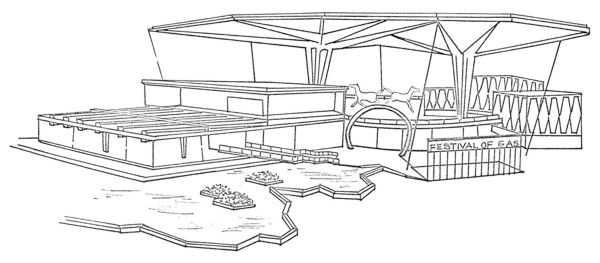
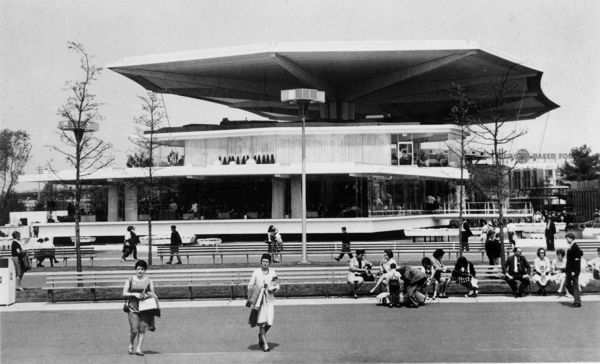
Architectural Model of the Gas Companies Pavilion (top). Artist's rendering of the Festival '64 Restaurant in the Festival of Gas (bottom)

SOURCE: Commercial Transparency by Photo Lab, Inc., Washington, DC

Architectural Model

Artist's Rendering

Letterhead

 FESTIVAL OF GAS STORY

FESTIVAL OF GAS PAVILION
FIRST AT THE WORLD'S FAIR

The Festival of Gas -- first at the New York World's Fair -- typifies the entire World's Fair in the sense that it has something for everyone ... young or old ... seeker of knowledge or seeker of fun.

The pavilion, sponsored by the gas industry, first to contract for space and break ground at the Fair, helped set the pattern that has been followed by most exhibitors ... entertainment and then ... education.

Designed by Walter Dorwin Teague Associates, the pavilion is a gleaming-white, open, spacious structure with pools, fountains, and colorful landscaping ... and it is a "fun" place.

Visitors will get their first preview of the pavilion while they ride a giant, gaily decorated Carousel, complete with huge, colorful prancing horses.

A number of special features, such as a Fun House, a Puppet Show, a Magic Show, a Garden of the Giants, a Pantomime Promenade, a Theater of Food, and one of the best restaurants at the Fair, will provide something of interest and entertainment for everyone.

Located on one of the main thoroughfares, the pavilion has an inviting, natural, park-like garden of amusement look which will draw Fair visitors.

A moving ramp will whisk people to the Carousel located in the heart of the pavilion twelve feet above the main floor.

From the Carousel, during a five-minute ride complete with narration, visitors will get a bird's eye view of the Festival of Gas and an introduction to special features of the pavilion.

At the end of the Carousel ride, another moving ramp will return them to the main floor and the entrance of the Fun House of the Future.

Visitors will enter the fun House on an outdoor ramp over a lagoon. Once inside they will experience a number of novel, amusing, surprising, and sometimes delightfully eerie adventures.

In the first section of the Fun House, engulfed in a weird eerie near-darkness, visitors will see the major milestones of man's use of natural gas -- from gas worship to gas use -- emerge before his eyes.

 
Source: American Gas Association Press Release - Presented Courtesy Gary Holmes Collection

- 2 -

Then they will be whipped on a magic carpet into the second section of the Fun House where the story of gas energy in the future will be told in a dazzling and dramatic display of multiple images accompanied by narration and music.

Finally in the third section of the Fun House, visitors will see the Gas Producer's Wishing Wells. Looking into the Wishing Wells, they will take part in the actual search for gas, land by helicopter on a sea-borne drilling platform, and see exhibits of everyday products, such as plastics which are actually "made" from gas.

Next on the tour of the pavilion is the Gas Transmission Pipeline Labyrinth where visitors will see a cross section of the intricate technology through which natural gas is stored, transported, and provided to industry and individuals when and where it is wanted.

The Festival's Magic show is a spectacular demonstration of the use of gas in industry, and particularly in the manufacture of glass. Visitors will actually take part in experiments and demonstrations becoming part of the Magic Show themselves.

The Festival's Puppet Show, featuring Tom Tichenor, famed puppeteer of the Broadway hit Carnival, is created to amuse both children and adults. It follows the adventures of Tom Therm in his battle against the elements and features a host of lovable Tichenor puppets which will work their way into everyone's heart.

Within the gay garden of amusement motif of the pavilion, visitors will find the Pantomime Promenade, a series of four miniature animated stage settings. These will dramatize the value of climate-control though "before-and-after" vignettes, featuring animated puppets.

The pavilion will also feature a unique way of displaying contemporary gas appliances within an entertainment theme. The appliances will set in a 24-foot high Ferris Wheel which revolves without center spokes. Festival of Gas visitors will walk through the center of the Ferris Wheel on their tour of the pavilion and the appliances will revolve around them.

The Festival's Theater of Food is a glass-enclosed, semi-circular, amphitheater where famous chefs from all over the world will perform. A new Guest Chef will be presented each week and from four to eight performances will be given daily. The Theater of food will hold 200 spectators for each performance.

One of the major exhibits at the 1964-65 New York World's Fair, which may rival television and and nylon exhibits at the 1939-40 Fair, is the Festival's Garden of the Giants.

In the garden a gas fired turbine demonstrates a dramatic portrayal of the industry's potential. The turbine, similar to those in jet airplanes, actually provides all the heating and cooling and a major portion of the electricity and power for the pavilion.

This is part of the industry's total air-conditioning story which is vividly being told in the fact that 80 per cent of the air conditioning at the Fair is being done by gas.

Another major highlight of the Festival of Gas pavilion will be the Festival '64 -- The American Restaurant -- which will feature regional American specialties. The restaurant with "see-through-walls" gives diners a pleasant unobstructed view of the fairgrounds, both night and day.

Set among the pavilion's pools and flowing streams, the Festival '64 blends into the garden-like atmosphere providing Fair visitors with a romantic, unhurried dining experience.The restaurant is managed by Restaurant Associates, operators of New York city's famed Four Season, The Forum of the Twelve Ceasars, and La Fonda del Sol.


energy vista

behind the scenes at Festival of Gas

Festival of Gas pavilion

By W. Dorwin Teague
Walter Dorwin Teague Associates, New York City 

A most vivid childhood impression was the sight of the huge crankshafts, connecting rods, and walking beams in the engine rooms of the Hudson River Dayliners. These old side-wheelers were nearly obsolete 40 years ago but one lesson can be learned which applies to the engineering problems of today. This effect of a little showmanship applied to the otherwise prosaic inner working of any large complex, whether it be a ship or an apartment building.

The polished steel and brass and spotless painted surfaces of the 60 year old side-wheelers served two basic purposes. First of all, they gave the engineers and their helpers a sense of pride in the operation and incentive to keep everything in top notch condition. Second, they gave the customers something to look at and a feeling of security and admiration for a management who obviously were not ashamed to let outsiders inspect their machinery.

 Design Invites Visitors to Inspect Equipment

In the Festival of Gas Pavilion at the Fair, designed and built under the direction of Walter Dorwin Teague Associates, the importance of making an attractive display of the central energy system and the associated air conditioning equipment is obvious. One of the most dramatic stories that the gas industries have to tell is the future of the on-site, gas powered, central energy system. It was essential that the actual working equipment should be an important feature of the exhibit.

The overall theme of the Festival of Gas Pavilion, as the name implies, was built around a "garden of amusement" concept. It is an indoor-outdoor design with planting and streams inside the building, as well as out, and no special line to denote where the building starts and stops. Originally the area under the large roof was to be enclosed with non-reflecting glass and air walls, but rapidly ascending Fair construction costs forced a change. The present open design reduced overall construction cost, but is based upon the original concepts.

All of the enclosed areas, the restaurant, the Gas Industries Club, the House of the Future, the Puppet Show and the Theater of Food are air conditioned, cooled and heated by the central energy system. All of the building lighting comes from the gas turbine generators and much of the power as well.

Central Energy System Tells Story

The central energy system is located in its own building to the rear of the pavilion. The front of this building is all glass and, like the glass in the restaurant, utilizes the new German developed hanging system which eliminates all frames or mullions. The energy plant consists of two 400 hp natural gas turbines, each driving a 275 kw generator. Only one turbine is used at a time and an automatic switchover system is incorporated. These turbines run at a constant speed of 38,500 rpm , and receive gas at a pressure of about 130 psig from a pair of natural gas compressors.

Waste heat from the turbines passed through a waste heat boiler which in turn supplies steam to a steam absorption refrigeration machine. Steam or chilled water is distributed to the various individual air conditioning units as required during each six month Fair period (April to October). Since the opening, there has been considerable interest by visitors in the total energy system which is explained by animated flow diagrams.

Higher Frequency Power

In an exhibit building of this kind, a high degree of dramatic lighting is required. For the main exhibit lighting, we use reflected light from the underside of the huge 30,000 sq ft overhead roof or canopy. A new 1,000 w mercury vapor lamp and a 400 cps ballast which makes full use of the superior efficiency of 400+ cps electricity for lighting was developed for us. The reflected light alone creates a level of 65 footcandles in the exhibit while the brilliance of the underside of the roof is almost dazzling in its effect.

Source: Excerpts reprinted from ACTUAL SPECIFYING ENGINEER, Vol. 12, No. 2,
Source: © Copyright 1964, Medalist Publications, Inc., Chicago 60616

Table Side Cooking

Since gas is traditionally associated with cooking, the Festival of Gas Pavilion features a deluxe restaurant, operated by New York's foremost restauranteurs, featuring American regional cooking. The most up-to-date and complete equipment is used in the kitchen and all lighting in the kitchen, the main restaurant, and the Gas Industry Club is produced by the total energy turbines. To emphasize the portability of gas as a power source, we designed a special gas-powered cooking cart. This cart uses a new infrared surface burner and a newly developed ceramic broiler-burner. Included in the cart is a gas-powered refrigerator and the combination provides restaurant captains with a portable kitchen capable of doing most cooking operations at the table side. Since the surface temperature of the broiler is intense, very little smoke is produced and these carts are in continual operation, a favorite with customers and restaurant personnel alike.

The House of the Future section of the pavilion deals with the role of gas in the future. In addition to exhibits on total energy systems powered by natural gas, the final section shows some actual sized appliances of the future, designed by our firm in connection with designers and engineers.

One of the problems in a two year Fair is to think of new and exciting exhibits for the second year. We expect to include an actual operating natural gas fuel cell in 1965, together with an exhibit explaining its role in on-site power generation in the future.

As time goes on, we predict that the sort of showmanship which makes the gas turbines and the air conditioning a major attraction in the Fair Pavilion will become more common in all sorts of buildings, shopping centers, developments and stores. The additional cost involved in cleaning up the central utility equipment and putting it in an attractive housing is more than compensated for by the good will this creates with the user and consumer and by the side effects of simplifying maintenance and creating a psychology of pride in the operators. The same philosophy that made the shining, oiled connecting rods of the old side-wheeler engine rooms so fascinating will transform the central power systems of our new buildings into showplaces that will delight visitors and maintenance personnel alike.


More Content