|
The Souvenir Book
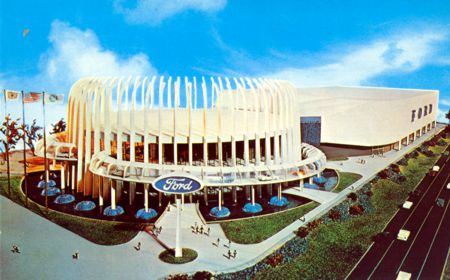
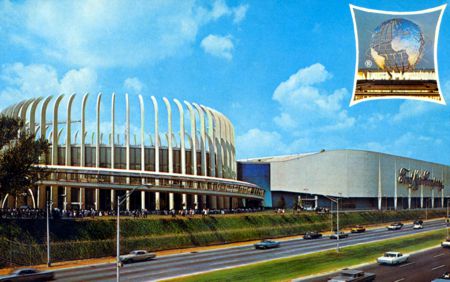
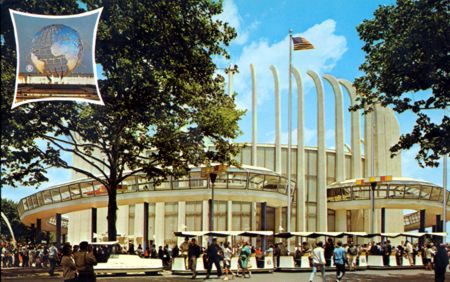
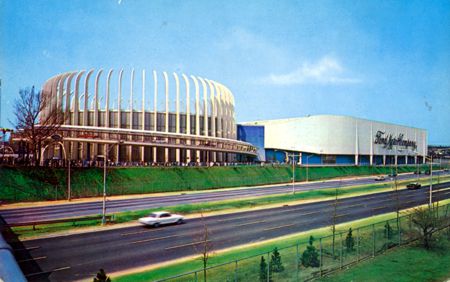
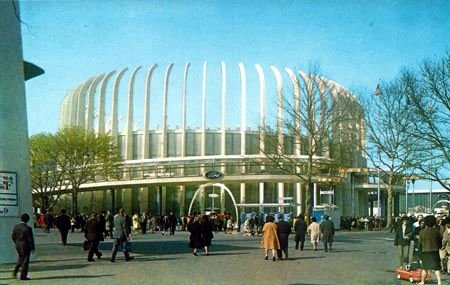
Welcome to the Ford Motor Company
Pavilion
|
|
Ford Motor Company is happy to
welcome you as its honored guest at the Ford Pavilion of the
1964-1965 New York World's Fair.
The Wonder Rotunda and the Magic
Skyway have been created to display Ford Motor Company and its
products in a novel and pleasant setting, and to express our
gratitude to the millions of people who have helped us on our
way.
This booklet is a memento of your
visit with Ford Motor Company that we hope was both pleasant
and exciting. We have spared no effort to make it so.
|
|
|
ENTERTAINMENT
ON THE grand scale is usually mounted in historic proportions
-- and that the Ford pavilion has. But the International Gardens
exhibit in the Rotunda area is a unique exception. |
|
|
This delightful Lilliputian world is
proportioned on a scale of one-half inch to the foot, and required
the combined artistry of twenty craftsmen working twenty-eight
thousand hours to create the exquisitely detailed reproductions
of the twelve countries represented. In the process they laid
half a million "bricks," attached three hundred thousand
shingles, and spread thousands of square feet of simulated grass. |
|
|
They also fashioned enough miniature
fences to enclose a city block, more than three hundred and fifty
thousand branches and trees, and hundreds upon hundreds of grapes,
apples, flowers and assorted fruits -- not to mention the world's
smallest wine bottle (it holds a single drop), the three pinhead-size
skylark's eggs for the nest atop the Danish windmill, and the
smaller than pin-size chopsticks used to dish out rice from a
bowl smaller than a child's thimble. |
|
|
|
| REFLECTING
THE DOMINANT theme of the Fair . . . "man's achievements
in an expanding universe" . . . is the Ford Pavilion's Theme
Center which comprises a replica of Henry Ford's original quadricycle,
the Theme Column and the Mural Wall. Although all are elements
of a unified design, each has its own distinctive story to tell. |
|
| The Mural Wall, one hundred and forty-five
feet long and twenty-three feet high, depicts in ninety-six sculptured
panels man's intellectual and creative progress through the ages
-- from early writing and arithmetic, on through his developments
in science, engineering, agriculture, architecture, power, the
arts, and finally to recent advances of the space age. |
|
|
|
|
| Symbolic of the Company's diverse activities,the
rotating Theme Column and its projecting elliptical planes tell
the story of the expanding world of Ford through graphic representations
of today's broad range of scientific and technological principles,
the numerous products that evolve from them, and the trademarks
of the Corporate divisions that produce and market these products. |
|
| Lastly is Henry Ford's hand-made quadricycle
of 1896. It was the beginning of a universal industrial revolution
in itself, and therefore little need be said of it -- except,
perhaps, to note the exact replica of the original runs as dependably
as its predecessor. |
|
| ON
THE MOVING upramp the mood becomes lighter as the sprightly tune
"PDSQ" -- Performance, Dependability, Style, Quality
-- is heard and the first of four life-sized dioramas comes into
view. This is "Performance" in the shape of Henry Ford's
famous "Old 999" racing car and its equally famous
driver, Barney Oldfield, who, according to Mr. Ford, "didn't
know what fear was." Neither, apparently, did Mr. Ford who
drove the "999" to a world's speed record of 92 m.p.h.
over the ice of Lake St. Clair, Michigan, in 1904. |
|
|
|
|
| "Dependability" comes next
and tells the story of a certain Dr. Phineas, the first M.D.
who recognized a good thing when he saw it by trading in his
horse and buggy for a Ford motor car. Incidentally, all details
of the four dioramas are authentically exact, based upon information
contained in the Ford Archives. |
|
| "Style," next, captures the
glamour of the times circa 1908 when for the first time the automobile
influenced fashion and the linen duster and shorter skirt became
de rigueur. |
|
| "Quality," forth and last,
is a legacy established in the old Highland Park assembly plant
that still benefits owners of Ford-built cars today. Then, as
now, careful inspection and thorough testing are basic principles
of quality. |
|
-
Source: VIP Souvenir
Book (presented courtesy of Gary Holmes)
-
Illustrations:
&COP The Walt Disney Company
|
|
| AFTER
ENTERTAINING sojourns with the "Model T Diorama," nostalgic
photo-murals, the "Decades of Progress," "Ford
Today," and the lyrical "Musical Assembly Line,"
guests are serenaded by the Parts Harmonic Orchestra -- the likes
of which they are unlikely to see or hear again. It's immediately
apparent there are no musicians, yet the twelve instruments bob
and weave as they play. Not so apparent is that all instruments
are made from actual Ford automobile parts. Brake cables stretched
between a drive shaft and part of a Galaxie frame become a harp;
trumpets are fashioned from sections of an axle. A xylophone
is created from rear spring leaves, and a banjo is shaped from
a differential housing. |
| Incidentally, guests may also note the
absence of an orchestra leader. The beat of the music is kept
by electric windshield wipers which move in unison on each music
rack. |
|