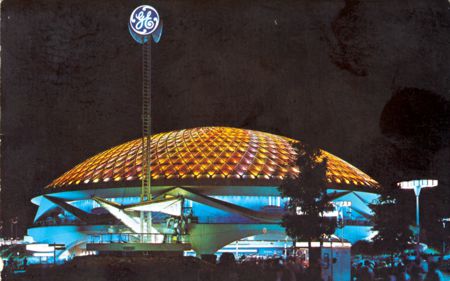
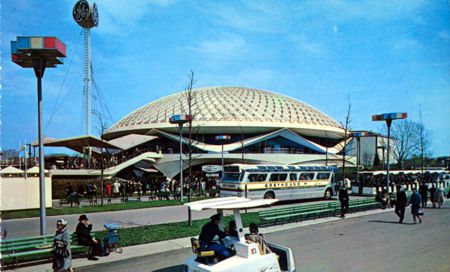
THE GENERAL ELECTRIC COMPANY PAVILION

AT THE NEW YORK WORLD'S FAIR

 
An Elegantly Domed Carousel
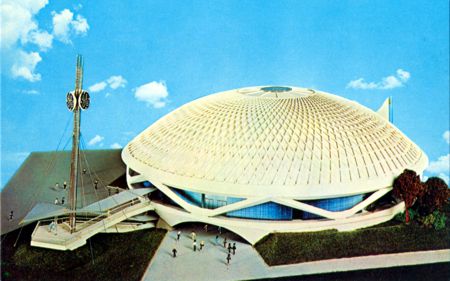
Artist's Black & White
 

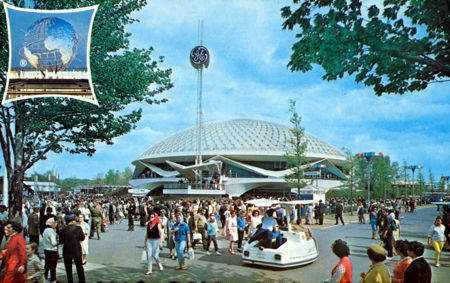
Full view of Dome

Meridians of Steel Tubing

Meridians of steel tubing spring from the ring girder (bottom), and support a lower course of horizontal hoops. Formed steel decking attached to the hoops was later covered with insulation, then plywood, then a continuous silicone rubber membrane.


Applying a decorative soffit

Here a decorative soffit is being applied to the all-welded ring girder, which is supported at eight points by sixteen sloping steel pipe columns, 18 in. in diameter, with 1-in. walls.


Plywood forms give architecural effect

Photographs above [and at top of page] show how the pipe columns were encased in plywood forms to achieve the desired architectural effect.

This is basically a round structure with an open center well, topped with a unique lamella pipe dome springing from a compression ring girder at the third level. The most unusual functional feature is a circular, rotating section, mounted on the steelwork at the second level, permitting the six theaters to rotate to each of six fixed stages. The exterior wall of the theaters is exposed to view under the deep overhang of the dome roof. The over-all effect is that of a sparkling carousel, its motion simulated by the spiraling pipe members of the dome.

THE DOME

This "crowning glory" of the General Electric Pavilion can be described succinctly as a 194-ft. diameter (to outside of ring girder) lamella pipe dome with a rise of 40 ft. It has two courses of steel pipe from which are suspended pipe hoops which carry the roofing material. The lantern (compression) ring at the apex is 43 ft. in diameter.

This framing system is extremely efficient. Weight of the lamella pipe and lantern ring is only 5.7 psf of roof area; 13.8 psf when the weight of the ring girder is added; and 16 psf if the hoops are included.

Of the structural steel in the building (about 750 tons), 120 tons are steel tubing. The 192 meridians required 16,000 lineal ft of 5-in. seamless tubing; the twelve concentric hoops required another 6,000 ft of four-in. seamless tubing.

The pipe members of the lamella dome create an interesting visual effect. Each of the meridians follows a constant curve in a single plane.

Pipe create interesting visual effect

In two levels, the meridians are pinned to the lantern ring (above) and to the girder ring (below), which take the thrust of the tubing.

Lantern ring at top of dome
Meridians pinned to dome base

Interior steelwork shows theater decking

Interior steelwork, including the ring girder, was erected before the dome. The lower level of steelwork at left supports the moving theaters; the sloping beams at center support the stages; the upper level of steelwork comprises a large exhibit area.


Cutaway sketch

Cutaway sketch shows one of the six theaters. The carousel rotates slowly, stopping in front of the six stages, each of which presents a different act. At the upper level, visitors view a show including films projected on the under surface of the dome (sprayed with asbestos for smoothness).


Carousel floor decking

Note the braced supporting members for the carousel. Stage areas, at left, are elevated above this level and slope up toward the center well.

INTERIOR FRAMING

The first floor is enclosed in a 21-foot high concrete foundation wall, much of which was later concealed from view by backfilling and landscaping. The wall is pierced by gracefully contoured entrance arches.

Eighteen-in. WF 45 radial girders are the main members supporting the theaters on the second floor. They are tied laterally with 8 WF beams, and are braced for additional rigidity with diagonal tie rods. At their "inside" ends, they tie into 24 WF 84 girders which form a twelve-sided polygon, supported on columns at each point, on an approximate radius of 54 ft from the vertical axis of the building. At their "outside" ends they are connected to the concrete floor system at the second floor level.

In plan, the lines of the radial girders are continued with 12 B 16.5 beams (typically) and extend inward with a slight upward slope. They support the floor of the exhibit area viewed from the theaters. Wide-flange hangers extending down from the third level framing pick up the inner ends of these beams, and help support a steel-framed ramp which spirals down through the center well and is additionally supported by steel columns.

Also, an 11-ft-wide moving ramp, carried on steel beams, extends from a point on the second level some 80 ft across the diameter of the center well to an opposite point on the third level. It carries the visitors leaving the theaters to additional exhibits above, after which they descend the spiral ramp.

At the third level, radial 27 WF 94 girders connect to the circumferential box girder and extend inward to support the top exhibit area. Inboard, these girders tie into a hexagon of 36 WF 300 girders, supported by six main columns. The radial lines are continued with 18 WF beams, from each of which are hung the 6 WF 15.5 hangers that extend to the second-level framing.

While it is true that all of the steelwork in the General Electric Pavilion can be readily disassembled at the Fair's end, and will have a very substantial salvage value, the inherently specialized nature of the framing for exhibit areas makes it unlikely that the entire building would be re-erected elsewhere. However, the GE dome obviously could be reused in any number of ways. Other than the welded box girder, all connections are pinned or bolted which, combined with the lightness of individual members, means that the dome can be taken down and re-erected at moderate cost.

Entrance/Exit Archway construction

Massive steel bents, all-welded except for the field-bolted knee braces, frame the entrance-exit arches.

Architect: Welton Becket and Associates; Exhibit Design: WED Enterprises, Inc.; Structural Engineer: Richard Bradshaw; Mechanical and Electrical Engineer: Syska & Hennessy, Inc.; General Contractor: Turner Construction Co.; Steelwork: Bethlehem Steel Company

Second level view shows ramp to pavilion "well"

View from the second level. Steel decking for one of the stage is in the foreground. Framing for the circular ramp is cantilevered from vertical hangers. The ramp will bring visitors down to ground floor exhibits from which they proceed to exits.

Bethlehem Steel Logo
 
Source: "World's Fair Preview" -- Bethlehem Steel Co. (Courtesy of Tom Wentland)

Aerial views of the General Electric Pavilion under construction. (Top) Spring/Summer 1963. (Bottom) Fall/Winter 1963.

Source: General Electric Pavilion publicity photographs presented courtesy Mike Kraus Collection.

GE Construction Aerial
(Top) Wald Disney inspects a model of the GE Pavilion in 1963 along with Gerald L. Phillippe, President, General Electric Corporation and Steven C. Van Voorhis, Manager, GE World's Fair Operations. (Bottom) Walt Disney speaks to VIP's at the General Electric Pavilion. The men in dark suits, arms folded, left center, are: Steven C. Van Voorhis (left) and Gerald L. Phillippe.

Disney, GE & Pavilion Officials wtih Model

Walt Disney at GE Pavilion Dedication


More Content