|
|
|
| the song |
-
THERE'S
A GREAT BIG BEAUTIFUL TOMORROW
|
|
Theme
of GENERAL ELECTRIC'S
CAROUSEL OF PROGRESS
Lyrics
and music by Richard M. Sherman and Robert B. Sherman
|
|
There's a great big beautiful
tomorrow
shining at the end of every day.
There's a great big beautiful tomorrow,
and tomorrow's just a dream away.
- Man has a dream
and that's the start.
He follows his dream
with mind and heart.
- And when it becomes a
reality,
it's a dream come true for you and me.
So, there's a great big beautiful tomorrow
shining at the end of every day.
There's a great big beautiful tomorrow,
just a dream away!
|
 |
SOURCE:
"Disney and the 1964 New York World's Fair," Persistence
of Vision Issue #6/#7, Paul F. Anderson, Author and Publisher.
© Copyright 2001,
Paul F. Anderson. All rights reserved. Reprinted here with permission.
THE CAROUSEL
OF PROGRESS AND "THE SONG"
(Excerpted
from "Disney and the 1964 New York World's Fair"
Persistence of Vision Issue #6/#7)
|
The Sherman Brothers and Walt
Disney in a G.E. "Update" film.
 |
Source: © The
Walt Disney Company, presented courtesy of Paul F. Anderson |
|
"Walt called us over to a meeting
at WED," remembered Richard Sherman, half of the song-writing
tandem known as the Sherman Brothers (then staff writers for
Disney). "He wanted us to come over and look at a mock-up
of the Carousel of Progress." Robert Sherman illuminates,
"He wanted a song, something that was a certain amount of
seconds, so when they moved the audience to a different stage
it would coincide with the time in between the move -- it was
a technical job."
Walt had a great deal of confidence
in his two song writers. He knew that they could create the kind
of song he wanted. Richard discusses Walt's request, "He
wanted a song that would fit in each style of the show -- a ragtime
for the 1920s, swing for the 1940s, and a sweet Mantovani sound
for the 1960s. Another challenge was that he wanted it to talk
about progress. You know, G.E. is always looking for new ways
to make life better -- but a soft sell. A singing commercial
without mentioning the product. We kind of understood what he
wanted, because we felt the same way about things. We always
believed in what we were doing."
The Sherman brothers set out to accomplish
Walt's assignment. "First, we worked back and forth with
the writers of the script -- there was a lot of give and take
-- but our job was to give Walt this theme song," recalled
Richard. "Then we went away for a couple of weeks, and we
thought, and we played, and we finally got something that we
really liked -- the title. And then we wrote the song. We devised
a way of talking about the idea of man looking for new and better
ways to live, and it was just a dream away -- you know the idea
of dreamers being the ones that dream up these things."
The now famous "There's a Great
Big Beautiful Tomorrow," was the result of this creative
collaboration. "We finished it, but we would play it for
Walt first," remembered Robert. Richard continued, "
He came down to our office on the third floor of the animation
building, and said 'What do you got?' We played it for him and
he said 'That will work fine. Can you play it like ragtime?'
So I played it like ragtime, and then I played it like a swing,
and he said 'Okay, we'll get the orchestraters in and that will
be fine.' That was his reaction." What may appear as a vague
response on Walt's part, was anything but. Robert explains, "He
was not one with superlatives. Once he said, 'That will work,'
that was a big compliment coming from Walt Disney.
--
Just a Dream Away --
Walt assigned Disney staff writers
Richard M. and Robert B. Sherman to write a tune that told the
story of the Carousel without giving away what was to happen.
The first music to be completed for G.E.'s Carousel was a song
entitled "There's a Great Big Beautiful Tomorrow."
Written in late February, 1963, this jaunty tune was quickly
arranged by staff composer Buddy Baker into the variety of styles
called for by the Carousel of Progress script. Though it seemed
impossible to isolate audio within each of the six sections,
or theaters, of the carousel as it rotated, Buddy Baker turned
this hurdle into an advantage. Working with the Sherman Brothers,
he planned the five musical transitions required to cover each
rotation of the carousel to start simultaneously, play in the
same key, and be exactly the same length. They were based on
"There's a Great Big Beautiful Tomorrow," and each
variation reflected the time period, or purpose, to which the
carousel was turning, i.e.: 1890s, 1920s, 1940s, 1960s, and Finale.
On March 6, 1963, several of these were recorded using eleven
musicians. The Overture interpolating "There's a Great Big
Beautiful Tomorrow," was followed by arrangements in musical
styles of the 1890s, 1920s, 1940s, and 1960s, as well as in Waltz,
Marching Band, Swing, Future and Dixieland versions. Rex Allen
recorded the vocal for "There's a Great Big Beautiful Tomorrow,"
and the patter for the carousel show. With music and dialog edited
together into a rough cut, this early version of the Carousel
of Progress provided the Disney creative team with the basic
idea of the show's timing and sound, and gave Walt a "dog
and pony show" to pitch to G.E. The show continued to evolve
with Walt and his Imagineers focused on the script and technology
of the carousel, leaving any required musical changes until the
show was closer to being locked. Although music budgeting continued
non-stop as changes were made to the G.E. Pavilion, no further
music was recorded until November 11, 1963.
-Alexander Rannie, Author
|
The
use of scrims in the Carousel of
Progress
|
Source - Photo: Bill Young
© 2002 Bill Young, All Rights Reserved
|

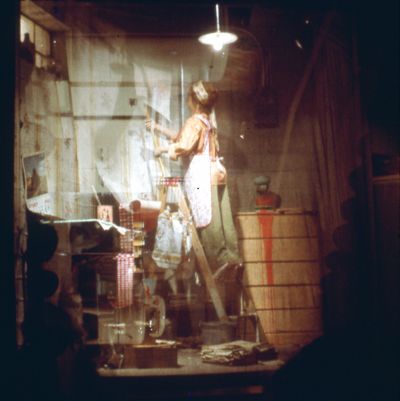
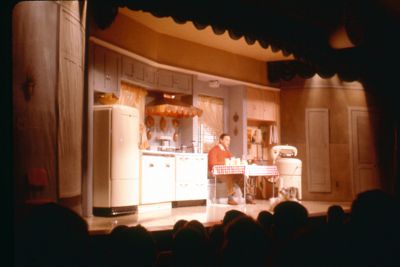
The highly
reflective nature of a scrim can be seen in this flash-photo
of the 1940s kitchen. Even though the action is lighted behind
the scrim, the flash reflects off the scrim the way normal stage
light does to obscure the action behind it.
|
The Carousel of
Progress sets made use of a theatrical device called "scrims"
to conceal smaller rotating stages at the left and right sides
of the main stage in the Act I, II and III theaters. This allowed
multiple scenes to be played out in each theater. A scrim is
a gauze-like curtain with a weave that is wide enough to allow
the action behind it to be seen when the lights are lowered on
the main stage. When the lights are up on the main stage, the
audience sees only a painted background. When the main stage
lights dim and the action is lit behind the scrim, the audience
sees the previously hidden stage. |
|
|
| the |
-
GATEWAY
TO FUTURE PROGRESS
-
and
-
GALAXY
OF SCIENCE & ENGINEERING
|
|
the
route to the Skydome Spectacular
|
|

Source - (Photo &
Description): Science Digest, Vol. 54, No. 6, December
1963
|
Left: "The
diagonal tube in the middle [of the model] is the "time
tunnel" which brings visitors from the revolving auditorium
on the second floor. A left turn takes them through the "corridor
of mirrors" [zig-zag pattern of walls on the model] to the
Sky-Dome, where a forces-of-nature display will be projected
on a giant screen above them." |
The
Time Tunnel and The Corridor of Mirrors
(Excerpted
from "Disney and the 1964 New York World's Fair"
Persistence of Vision Issue #6/#7)
|
SOURCE
(Tube & Corridor Description): "Disney and the 1964 New
York World's Fair," Persistence of Vision Issue #6/#7,
Paul F. Anderson, Author and Publisher. © Copyright 2001, Paul F. Anderson.
All rights reserved. Reprinted here with permission.
|
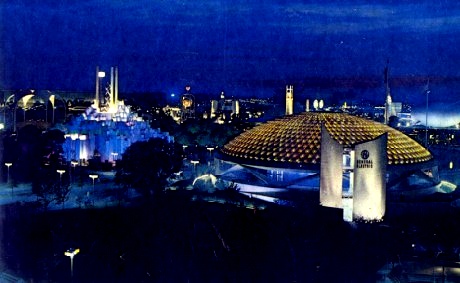
The Carousel of Progress, which was
the first portion of Progressland, was on the second floor of
the pavilion. When the audience was invited on stage in the final
act ... they entered a moving ramp that would take them up to
the third floor's show ... The ramp developed into a tube enclosed
in special mirrors which created a kaleidoscopic montage by reflecting
activities in the area at the top of the ramp. This was a natural
progression, because when the audience emerged on the third floor,
they would find themselves in the 160-foot long "Corridor
of Mirrors."
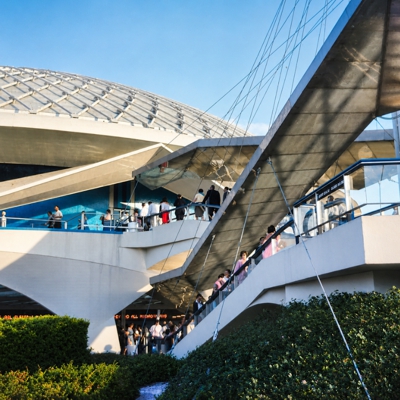
Visitors
file out of the Finale theater and up "The Gateway to Future
Progress," as the "Time Tube" moving ramp came
to be known.
Source: Photo Network
© 2002 Photo Network, All Rights Reserved
 |
Something that G.E. expressed interest
in having in the Pavilion was an exhibit(s) that would showcase
their employees and the job they were doing. "We wanted
something so that our share holders could see what we were doing
and be proud of," expressed [Pavilion Manager] Steve Van
Voorhis. "The Corridor of Mirrors," the early working
title, was the result -- the name was later changed to the "Galaxy
of Science and Engineering." It featured hundreds of simulated
stars twinkling overhead, as constantly changing color photographs
of G.E.'s research, development, and engineering activities were
projected on screens etched in the huge mirrors. Each project
area was in the form of a symbol aligned with basic sciences.
After walking through the mirrored
corridor, the audience would come to the second big show planned
and designed by Disney, "The Skydome Spectacular."
|
General Electric shows the
progress of presentation by projection
General Electric's Fair pavilion
includes a free-flow area dotted with reflected, ever-changing
photographs. This "corridor of mirrors" is known as
the Galaxy of Science and Engineering
 |
|
Source: Industrial
Photography, Volume 13 No. 5, May 1964
|
Projected photography produces [a] Progressland
highlight -- the Galaxy of Science and Engineering. Silvered
from floor to ceiling, this free-flow area is a "corridor
of mirrors" dotted with reflected, ever-changing, photographs
of actual General Electric scientists and applied engineers doing
basic and applied research and development -- research in space,
in electronics; research for electric utility companies and for
industry, for the home and for the nation. The walls and ceilings
of the corridor are embellished with Technamated abstract designs.
16 Screens
Captioned color pictures appear in 16
various-shaped "screens" (about six by six feet in
size), linked by animated elements. They stay on the plate-glass
mirror screens from three to five seconds, are wiped away by
a warm flood of complementary color (rather than going to harsh
white), and are replaced by other pictures.
The screens rotate from two to six pictures
each, out of synchronization with one another, so that the effect
is that of pictures fading on and off in seemingly endless vistas.
Concealed behind the lenticular no-fall-off
screens are the sources of the pictures, 16 2000-watt Bodde rear-screen
projectors. Each has been equipped by the Disney organization
with a prism that produces the wipe effect mentioned above.
Bounce Projection
Some of these units project their 4x5
slides directly onto the etched glass screens they serve. However,
most, because of space limitations, project onto first-surface
mirrors, which bounce the images to the screens. In the case
of some, a triple throw is involved: projector to mirror to mirror
to screen.
Because of space limitations,
most of the rear-projected Galaxy pictures are thrown onto mirrors,
which bounce the pictures to the screens.
 |
Both the projectors and the mirrors
are securely anchored, so vibration is no problem. Air-conditioning
filters out most of the dust that might settle on the mirrors
and cause distortion. The rest is blotted off with chamois cloths
and distilled water.
|
|