Archways to Understanding

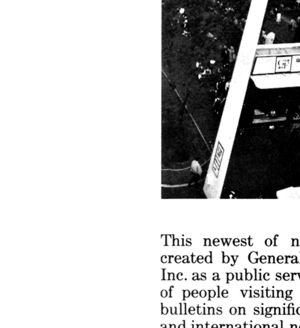
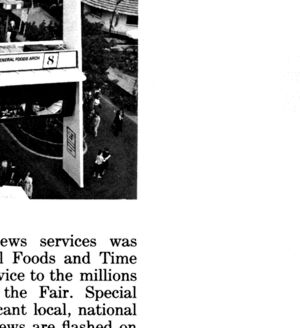
Detail of Archway Display Panel

The biggest continuous rolls of translucent photo reproductions ever made are part of General Foods' unique communications network at the Fair. 

Visitors to the New York World's Fair are getting glimpses of the biggest continuous rolls of translucent photo reproductions ever made, and their first look at translucent photos that appear to be prints during daylight hours and vivid transparencies when backlit at night.

Color Corporation of America produced 45 king-sized photo tapes for General Foods Corporation to install in its 11 "Archways to Understanding" at the Fair. The arches, bearing electronic message boards, flash a steady flow of news and other useful information. They are located at high-traffic points throughout the 646-acre Fairgrounds. Four of the Arches have double-sided panels, with messages visible from both sides of the structures. The other seven utilize single-sided panels.

Directly beneath the information panels are mounted three rectangularly shaped, single-faced photo panels. Behind these three viewing screens are three rolls of photo tape printed with a series of scenes relating to the Fair's official theme, "Peace through Understanding".

The tapes move horizontally on rollers, first left to right until all frames are shown, and then right to left. The speed with which each roll of film moves is determined by an automatic timer operated from a single, central, remote-control console located in the World's Fair Administration Building.

Each of the tapes measures 66 feet in length. Laid end to end, all 45 tapes would stretch out to more than half-mile. There are 10 different scenes on each tape, four in full color and six in black-and-white. Each scene is six feet long and nearly three feet high.

Production of the giant tapes proved to be "the toughest challenge we've faced since our company was organized 14 years ago," said Joe Snyder, president of the Tampa-based Color Corporation.

"Printparencies"

The photo tapes are actually "Printparencies" -- a word coined to describe reproductions that appear to be prints when viewed in reflected light and transparencies when seen by transmitted light.

The pictures are printed on Cronar, DuPont's photo-sensitized polyester material. Best known for its stability, Cronar also has high tensile strength, important in this function, where the tapes are pulled back and forth. In order to unwind completely every 30 minutes, so that viewers can see all 10 scenes, each 66-foot photo tape moves more than a quarter of a mile every 12-hour Fair day. All together, the 45 tapes will have logged some 5,000 miles of winding and unwinding by the time the Fair closes.

Cronar's most attractive quality, however, from the standpoint of this application, is that it does a good job of both transmitting and reflecting light, essential for this display.

Illustrate Fair's Theme

Eight of the 10 scenes on each tape illustrate the Fair's theme in terms of human experience. General Foods and its ad agency, Benton & Bowles, scoured photo libraries and other collections for weeks assembling dramatic photos on these specific subjects: education, sports, music, religion, industry, travel, children and the United Nations. One three-photo sequence, for example, shows a pianist's hands on a keyboard, trumpeter Louis Armstrong in action and a Salvation Army band. These scenes represent music as a universal language for understanding and good will. Two scenes on each tape show General Foods products. These product shots are on display only 8 1/2 minutes every hour.

Color Corp. worked with a variety of artwork, including 35mm transparencies. Copy prints were used for all the black-and-white work.

Special Racks

Handling 70-foot rolls was no easy task. Special racks to hold the material and special rollers to advance it were required.

The color images were applied to the Cronar by the dye transfer method, the first time this has been done.

Despite the difficulties, Color Corp. was able to complete the job in a little over three weeks by working around the clock.

Despite exposure to all sorts of elements, the pictures are expected to hold up well for the two years of the Fair.

Information Panels

Mounted above the 31-foot-wide base of each Arch is a horizontal single or double-sided illuminated information panel, measuring six feet high by 24 feet wide.

Each of the 15 information panels (seven singles and four double-sided) has 210 alpha-numeric indicators arranged in five horizontal lines of 42 lamp banks (and thus, 42 characters) per line. Each indicator consists of a "matrix" or cluster of incandescent lamps, seven lamps wide by nine lamps high, which display characters approximately six inches in height. These characters are legible for 300 feet. All characters from A-Z and 0-9 can be posted; also a hyphen, apostrophe and a "blank." Special sunlight filter screens, similar to those used on electric scoreboards, insure daylight visibility of incandescent figures and letters.

Copy is transmitted electronically from the remote-control console in the Administration Building.

This control system employs a manually-operated "printer," which is operated much like an electric typewriter. As the operator types on the keyboard, one copy of the message is produced in normal print, for use in verifying input. Simultaneously, the message is coded on a tape, which the operator then feeds into a small "reader" the size of a shoebox. It is this reader which flashes the message to the information boards. Messages appear on the boards letter by letter, left to right, just as they would if hand-written one line at a time. Posting of the full five lines takes 20 seconds. As an additional feature of the system, information on the panels may be moved up one line at a time, so that the top line disappears and the second line from the bottom becomes line one, and so on.

***

Source: INDUSTRIAL PHOTOGRAPHY, Vol. 13, No. 5, May 1964


GF Archway #9 - Located in the Transporation Area near the Ford Pavilion
GF Archway #9 

Source: Photo courtesy of Bill Cotter, © Copyright 2000, all rights reserved.


More Content