With "hood" at one end and "tail fin" at the other, GM's shape suggests a car. And a popular one, as attested by crowd waiting alongside pavilion to ride the Futurama inside.

Source: News Colorfoto by Daniel Jacino, New York Sunday News, September 20, 1964

GM Day View

Same View - Night

Source: Wolfe Worldwide Films

GM Night View


Millions will again flock to GM to ride the Futurama, 1964's No. 1 attraction.

Source: General Electric Colorphoto by Daniel Jacino, New York Sunday News, April 25, 1965

Night View of canopy

Futurama Logo

NEWS

for release IMMEDIATELY

WORLD'S FAIR -- What does it take to build the number one exhibition at the New York World's Fair?

Well, for one thing, it takes shower curtain rings -- 6,000 of them. And you put in 3,000,000 staples, 33,000 artificial plants and two tons of simulated snow flakes. You use up 5,800 gallons of glue and drive five-and-one-half-tons of nails.

More importantly, it requires a wealth of stylists, engineers, researchers and other experts to conceive and design a panoramic adventure into what the world of tomorrow may well be like. The passenger conveyance system, which has flawlessly carried more than 70,000 persons a day on a 15-minute ride through the jungle, the desert and city, past the surface of the moon and the antarctic and under the ocean, is in itself a design and engineering achievement.

On an 8 1/2 acre site within the Transportation Section of the fair General Motors has constructed a 230,000-sq.ft. exhibit which promises to outdo its Highways and Horizons display, the most popular attraction at the 1939-40 New York World's Fair.

Far broader than its predecessor which encompassed only the United States, GM's new Futurama offers visitors a trip around the world of the future if man builds with only the tools and techniques he has already perfected.

Depicted are new modes of living; transportation innovations; vehicles unlike any seen today; startling advances in scientific research; communications techniques which outspeed and outdistance any now in use; revolutionary industrial and agricultural processes.

To create this wondrous world, members of the GM Styling Staff, who designed the entire ride and other exhibits in the building, asked themselves three years ago - "What are man's needs? In what areas will he most probably strive to advance his technology, satisfy his scientific curiosity, improve his lot in life?"

With these areas determined, the Styling Staff designers developed a forecast of the courses man might follow. They then went to the experts for verification.

To present their findings, the GM stylists decided to create environmental scenes in which the innovations they foresaw could be shown advancing the fortune of all mankind. Viewers would take the "ride into tomorrow" in moving lounge chairs.

The scenes were constructed in a studio near Detroit. When complete, they were sawed into sections, trucked to the Flushing Meadow site of the fair, reassembled and installed along the third-of-a-mile Futurama ride track.

"This was a very stimulating project for all our people," said William L. Mitchell, GM vice president in charge of Styling Staff. "Many of them were rotated to the Futurama project from their normal tasks both to make specialized contributions and to let them do some real 'blue sky' designing. They found it easy -- and exciting -- on a project of this size to imagine that they were already living in this magnificent world of tomorrow that they visualized. That was possible because everything we show is founded on scientific fact."

A host of skills was called into play during the creation of the scenes. GM experts in advanced vehicular design, in lights and colors and textures, in modeling and building and painting, in theatrics and illusion and sound and in myriad other fields were called upon.

The ride itself, which calls for the loading and unloading of a person every second, was a particular problem. GM engineers solved it by inventing a new type of drive mechanism.

GM, which has staged automotive, scientific and other types of shows across the country for some 117 million visitors, had a wealth of talented and experienced individuals on hand. They were responsible not only for the ride but for the design of the building and two other attractions which it will house -- a display of the contributions science is making to the progress of mankind and an exhibition of GM automotive and other products.

The H. B. Stubbs Co. was called upon to do the actual construction of the scenery. At its studio in suburban Detroit, Stubbs craftsmen -- working from the Styling Staff's design -- built the scenes, numbered every section and then cut them into pieces which could be transported in a special fleet of 50 trailer trucks.

The sets were built upon wooden frames which were then covered with wire screening. "Mud," composed of powdered asbestos, water soluble glue, wheat paste and coloring -- with sodium benzoate added as a preservative much as it is used with prepared foods -- was sprayed on in several layers. The surface was then painted to represent varying types of terrain.

At the Futurama building other employees put the pieces back together, installing almost a mile of animated track upon which miniature vehicles, human figures and other objects travel and mounting some 900 stage lights. An additional 1,500 lights ranging from a Christmas tree bulb to a 500-watt quartz lamp were also used.

In constructing the scenes, which run for more than a quarter of a mile through two levels of the Futurama building, the Stubbs craftsmen used more than 10 acres of plywood, 225,000 feet of lumber, 120,000 carriage bolts, 135,000 wing nuts, 12,100 feet of aircraft cable, 135,000 sq. ft. of screen wire, 46,000 feet of paper rope, more than 5,000 gallons of fire-retardant paint and nearly 13 miles of electrical wiring.

The GM Styling Staff made in miniature some 1,900 vehicles, close to 1,300 model trees and more than 9,000 human figures.

The shower curtain rings? They'll be used to support some 30,000 sq. ft. of scenic backdrops painted by the Metro-Goldwyn-Mayer scenic artists in Hollywood.

* * *

Source: GM Press Release

Model Closeup - House of Tomorrow

House of Tomorrow model

Model Closeup - City of Tomorrow
 
Source: Wolfe Worldwide Films
Source: Bradd Schiffman Collection

City of Tomorrow Model


 Lets go to the Fair Brochure

Examples of promotional brochures found at the Fair

 See the Future First Brochure

and distributed by GM dealers to potential Fairgoers.

If You've Only Seen it Once Brochure 


SOURCE: GM Advertisement, National Geographic, April, 1965

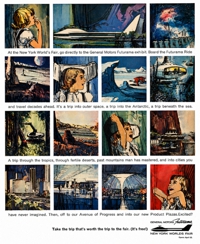
High spot of the New York World's Fair reopening this Spring -- GM Futurama!

You can look over GM's exciting "idea" cars -- Firebird IV with television, stereo, game table, refrigerator; GM-X with jet aircraft cockpit and controls -- fascinating design and engineering innovations right out of tomorrow.

You'll take a ride that is wrapped in wonders . . . through the metropolis of the future, over Antarctic wastes, into tropical jungles, along the ocean floor.

You can count on the people of General Motors again to provide the most popular show at the Fair -- the Futurama.

General Motors is People...
making things better for you


More Content