|
Across
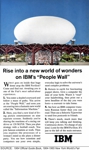
the grove of steel trees, where twinkling lights spell out INFORMATION
MACHINE, you pass through an arch into a maze of elevated walkways.
No matter which path you take, left or right, up or straight
ahead, all paths lead to your destination: a seat on the People
Wall that will carry you into the great theater that rests on
top of the trees.
On
the walkways, strolling entertainers keep you amused while you
wait for the next show. You watch the People Wall descending
from the raised theater. Those who have just seen the show file
off, and now it's your turn.
You
leave the maze and take your seat on the Wall. Before you, the
ever-changing fountains of the Pool of Industry send white plumes
skyward; below, IBM's reflecting pool riffles in the breeze;
above and behind you, through the great doors swung open in the
bottom of the theater, you catch a glimpse of the shadowy interior
of the Information Machine itself.
Every
seat on the twelve tiers of the Wall is taken. About 500 people
wait with you to be carried upward into the Information Machine.
Suddenly, from an opening in the green canopy overhead, your
host drops down, riding a tiny platform. A quick welcome to the
Information Machine, and he disappears up into the theater as
suddenly as he arrived. Then the 60,000 pound Wall carries you
smoothly upward in full view of Fairgoers on the ground.

You
rise into the darkness of the theater, the huge bay through which
you entered is drawn up, the world is closed out, and the show
begins. You adjust quickly to the dim light inside the Information
Machine -- and soon you make out the multi-faceted interior,
the fifteen screens of various shapes and sizes that line the
curved wall. Suddenly your host reappears on a balcony before
you. As he starts to explain that this is really an information
machine -- because it is a way of telling you quickly and vividly
all sorts of facts -- the screens burst into a blaze of light
and color. Some of the pictures move, some are still and flash
on for brief moments before vanishing -- but always the pictures,
the sound, the host himself are woven into a coherent whole.
At
the bidding of the host, information leaps at you from all directions.
Just to show what the machine can do, he fills the screens with
miscellaneous information about himself -- his credit card, the
change in his pocket, what he had for breakfast, what's inside
his closet, even a little chat with his mother up in Schenectady.
Another
example, he announces -- and suddenly you are in the roaring
midst of a road race. With all screens filled with action, you
see far more than if you were actually on the spot: you are in
many places at once, on the curves, in the pits, with the onlookers,
in the driver's seat, inches from the ground next to the front
wheel ...
"That's
how the Information Machine works," your host tells you. "Now
this is how we would like to use it ... You'll see that the method
used today in solving even the most complicated problems is essentially
the same we all use daily ... "
And
now you are surrounded by railroad engines and tracks and freight
cars and the things they carry. Running a railroad is a complex
problem; to make it manageable, the many parts are reduced to
simple terms and abstractions -- from apples to barrels, to waybills,
to freight cars, to lists, to numbers fed into a computer.
Abstractions
-- symbols, numbers, formulas -- are used by many people to make
"models" used in solving real-life situations. Weather
forecasting, for example. Gathering weather data is a worldwide
job. fifty thousand observations are made all over the globe,
and the information is coded and exchanged among nations. To
use this immense amount of data to predict what the weather is
going to be, scientists have developed a mathematical model --
a series of equations that describe the interaction of weather
forces such as winds, clouds, and masses of air at various pressures.
The latest weather data are fed into data-processing systems
and manipulated mathematically in accordance with these equations.
The answers that come out are very practical ones. A reliable
weather forecast is important in all sorts of decisions, from
estimating how many hot dogs to order for tomorrow's baseball
game to determining precisely where and when a hurricane will
strike the mainland and what course it will take afterwards.

The
Information Machine dramatically illuminates the weather problem.
"Thunder," your host demands, "Lightning!"
With a crash and a flash of light ...
The
weather model is a highly complex one that requires teams of
specialists and high-speed computers. But as the Information
Machine demonstrates, models come in all shapes and sizes.
Listen
to a football coach describing a pass play to his team: "...
good fake to the fullback off-tackle, drop back, keying in the
defensive halfback. As he rotates up, we want you to hit the
right end going up the field and to the corner ..." The
diagram that the coach draws on the blackboard is a model of
an actual play -- or at least what he hopes the play will be.
To the members of the team, the blackboard symbols represent
the real thing. The game itself will reveal how good a model-maker
the coach is.
Many
of the models we use in daily life involve much the same steps
as those taken by the football coach -- or the scientist. Take
such a simple example as planning a dinner party. The hostess
faces the challenge of seeing that the guests sit next to people
they enjoy and at a distance from those they might not get along
with.
The
hostess visualizes her first model of the seating arrangement:
The Coopers will be fun ... What does that do to the seating?
Let's see ... Jane on Harry's left .. Mrs. Townsend on the right
... Actually, the plan can be more complex than it first
appears. There are, after all, thousands of different ways to
seat 10 guests along the two sides of a table. As she shifts
people around to find the best arrangement, the hostess makes
notes and finally draws a rough diagram of the seating plan --
her personal model -- until she finds the right combination.
Later,
a glance down the table as the dinner is under way tells her
that her chosen model was the right one -- the guests are chatting
happily -- the party is a success.
Most
people think of models as three-dimensional copies of the real
thing -- like this miniature of the X-15 rocket plane being tested
in a wind tunnel. Engineers test this low-cost model to find
potential problems and eliminate them before going to the expense
of building the actual aircraft.
The
flight characteristics of aircraft can also be modeled as equations
-- and these mathematical models can be manipulated with even
greater flexibility than the miniature in the laboratory tunnel.
Such a mathematical model can be put through tests simulating
every experience a real plane would meet in flight. Here, however,
the equations are extremely complex, and paper and pencil manipulation
becomes too expensive and too slow. A computer can solve complex
equations in minutes or seconds, sometimes in fractions of seconds.
Accurately and tirelessly, the computer can trace out the consequences
of a thousand possible actions, can pick out the best design
from thousands of possible designs, and can shorten development
time.
This
technique enables engineers to stress-test a design or materials
without risk to aircraft or pilot, and at a small fraction of
the cost of building a full-scale airplane.
"...
Let this be the air, this the plasma, and this the red cell ...
We represent chemical reactions as mathematical equations. Now
if the model -- that is, this group of equations -- is right,
it will behave remarkably like a human system ... With a computer,
we can play with the model directly ..."
Those
words were captured during a laboratory discussion among scientists
developing a mathematical model to study the interaction of oxygen
and hemoglobin in the blood. Biological research has always been
handicapped by the difficulties of testing how living systems
actually work. The interaction of many complex factors makes
it hard to study the effect of any one singly, especially since
biological processes are often hidden away where they cannot
be observed directly. By manipulating the equations of their
model in a computer, scientists can perform the equivalent of
a physical experiment -- before trying the real experiment in
the laboratory. Such simulations make possible intensive study
of human biological systems, to help determine how they respond
when attacked by disease and what treatments have promise of
success.
Information
-- as the Information Machine itself makes plain -- is the key
to solving problems. But in most cases the information must be
processed logically or mathematically before it can be put to
work. Usually this means putting the known information into an
abstract form. The hostess represents her dining table with a
rectangle, the guests with circles and initials. The football
coach has a symbol for each of the 22 players and the ball, special
symbols for movement. Weather scientists turn winds and air pressures
into numbers.
The
abstract symbols or numbers can then be put together into a model
that describes their relationships and represents the problem.
The hostess maps her dining room, a very simple model of a simple
problem; she manipulates her model by varying the positions of
her guest-symbols until she arrives at the happiest -- or "optimum"
-- seating arrangement. The football coach has a more complicated
problem because his symbols must move, so he makes a series of
maps on the blackboard. The problems of the aircraft engineer
and the weatherman are highly complex and their models contain
so many different variables with such intricate mathematical
relationships that high-speed computers are used to manipulate
the symbols and help solve each problem in a practical length
of time.
But
even when a computer performs the calculations, it is the human
model-maker who is really responsible for solving the problem.
His ability to translate information into abstract terms and
organize these abstractions so that they simulate an actual situation
are all-important. Frequently just making the model tells him
a great deal about his problem. As the narrator in the Information
Machine says in closing:
"Computer
problems, philosophical problems, homely ones -- the steps for
solving each are essentially the same, some methods being but
formal elaboration of others.
"But
homely or complex, the specific answers that we get are not the
only rewards or even the greatest. It is in preparing the problem
for solution, in these necessary steps of simplification, that
we often gain the richest rewards. It is in this process that
we are apt to get an insight into the true nature of the problem.
Such insight is of great and lasting value to us as individuals
and to us as a society."
With
a burst of music, the pictures on the screens fade away, your
host comes back to say goodbye. Below you, the great doors swing
open. The People Wall glides slowly back to earth. The show is
over.
|