2 Computer Court


 Optical Scanning and Information Retrieval

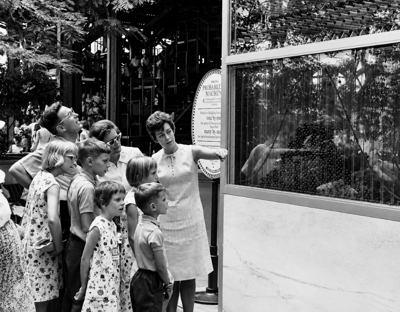
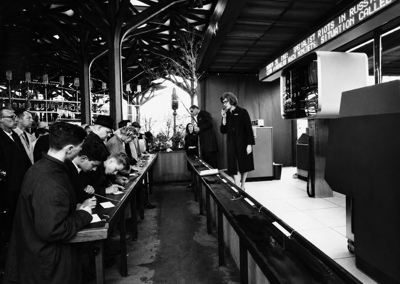
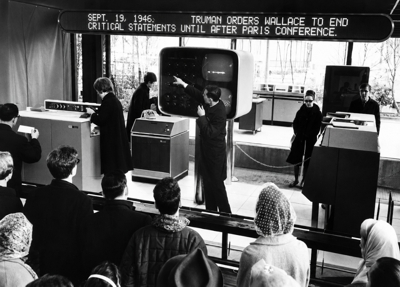
Across the way, where the crowd is watching the bright lights of a display board spell out numbers and messages, you can see one of the newest developments in information-handling devices. For here is a machine that can read numbers just as you write them down.

Filling out an Optical Scanning Card

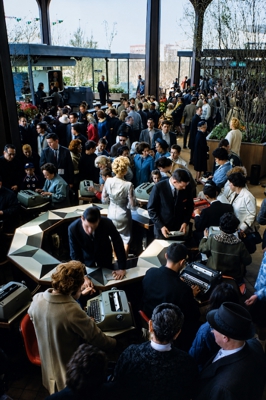
At two long counters, visitors are asked to select any date since 1851, and to write that date on a card. A visitor hands his card in -- marked 3-6-1861 -- and the operator feeds it into the experimental optical scanner of an IBM data processing system. In a fraction of a second a tiny electronic scanning beam has outlined the contours of each number by traveling around it in a series of continuous circles, in much the same way that children trace letters for penmanship exercises. The electronic scanner identifies this pattern as a specific numeral. Information about the number is transmitted as a series of electronic pulses to a computer at the IBM Pavilion.

The entire number -- the date -- is then compared with 40,000 numbers in the computer's "memory" or data storage system. Stored with each date is an important news item of the New York Times, one for every day since the Times started publishing in 1851. This item is now transmitted to the computer's output unit, which prints it on a souvenir card -- and also flashes it in lights over the exhibit. There it is for MARCH 6, 1861: PRESIDENT LINCOLN'S INAUGURAL WORDS TO THE SOUTH: 'WE MUST NOT BE ENEMIES.'

IBM Hostess explains Optical Scanning equipment

The day the World's Fair opened, a visitor at the IBM Pavilion tried to stump the machine by giving it a date in the future. However, the computer had been programmed to cope with such requests. It printed out a souvenir card that read: "THE DATE YOU HAVE REQUESTED WAS FEBRUARY 3, 1970. SINCE THIS DATE IS STILL IN THE FUTURE, WE WILL NOT HAVE ACCESS TO THE EVENTS OF THIS DAY FOR 2,113 DAYS."

Inserting information into a computer from handwritten documents -- such as inventory lists, sales slips and scientific laboratory data -- has always been one of the slowest steps in automatic information processing. The usual method has been to convert the handwritten data into computer "language" by typing it on a coding machine or punching it on cards. Eventually, machines that can interpret handwriting directly will shorten the time it takes to process information, and will help man take fuller advantage of the electronic speed of computing systems.


 Souvenir of Optical Scanning exhibit

A souvenir card from IBM's Optical Scanning Exhibit. The message reads: "THE DATE YOU HAVE REQUESTED WAS 4/20/9986. SINCE THIS DATE IS STILL IN THE FUTURE, WE WILL NOT HAVE ACCESS TO THE EVENTS OF THIS DAY FOR 2929976 DAYS. HOWEVER, WE WOULD LIKE YOU TO HAVE THE FOLLOWING NEWS EVENT REPORTED IN THE NEW YORK TIMES OF FIFTY YEARS AGO: APRIL 19, 1914: PRES. WILSON GIVES MEXICO UNTIL 6 P.M. TO SALUTE U.S. FLAG AS REPARATION GESTURE." The card is dated 4/19/1964 -- three days before the Fair opened!


Automatic Language Translation

At the next IBM demonstration another crowd has gathered, intently watching a typist copy sentences from a Russian scientific article. A television screen shows the words in the Russian language alphabet as they are typed. Seconds later, another screen shows understandable English sentences being typed automatically on a printer opposite the typist. The demonstrator explains that the English is a direct translation of the Russian text -- with a computer doing the translating.

Translating Russian into English

In the few seconds between typing and translation of each sentence, the text has been transmitted 90 miles to an IBM laboratory at Kingston, New York, translated sentence-for-sentence by a computer, and sent back to the output printer at the World's Fair. the English translation is not grammatically perfect, but it's sufficiently clear to tell the interested reader what the subject matter is about, and whether it is worth studying in closer detail.

To make the translation, a light beam searches a plastic "dictionary" disk that has been imprinted with the microscopic code for 200,000 Russian words and their English meanings. It takes 1/40th of a second for the beam to find a word and report its meaning to the computer. Translation, however, is much more complex than merely looking up the meanings of words in a dictionary. Before a machine can translate any language effectively, language experts must first analyze tens of thousands of words, phrases and sentences and carefully set down the rules of syntax and grammar that describe many of the ways those words and their variations can be used. Then rules must be stored in the translation machine's "memory" device, so that the machine can apply the appropriate rules to each sentence and produce an understandable translation.

Languages are so rich and complex that experts are a long way from the precise definition of all grammatical rules for any language. It may never be possible for a computer to translate the delicate shades of meaning found in a sonnet. For the scientist and engineer, however, machine translation promises to make the world's technical literature more readily available.

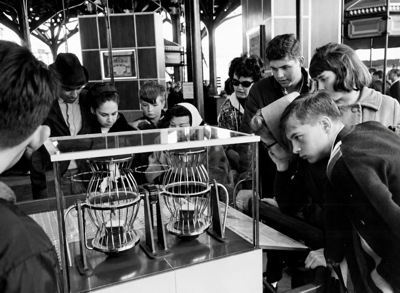
Dictionary disk sample

Above, a young visitor peers through a sample of the "dictionary" disk used in IBM's machine translation system. On the original transparent disk, an imprinted band about half an inch wide contains black rectangular code symbols for some 200,000 Russian words, together with their English meanings. On the little girl's sample, the rectangular symbols have been enlarged so they can be seen by the naked eye.

Today, in an age of rapid scientific discoveries, human translators cannot keep up with the flood of technical information rolling off the world's presses in French, German, Russian and many other languages. For example, only one American scientist out of every thousand reads Russian -- yet more than ten billion words on scientific and technical subjects will be written in Russian this year alone. Less than one percent of this will be read by English-speaking scientists, because translations are not available.

Once an automatic language translation system is in operation, translations can be produced by people who don't understand the foreign language with which they are working. It isn't difficult to type in a language you don't understand -- even if the language has an unfamiliar alphabet. Using a Cyrillic alphabet typewriter, the typists at the IBM translation demonstration cheerfully copy Russian articles on advanced physics without knowing anything about either Russian or physics.

Visitors translate Cryllic letters into English

You can try it yourself at the Fair. Like the boy typing a postcard in the picture above, you simply look up the Cyrillic letters in a chart and then find them on the typewriter. It's slow at first, but if you kept at it you'd soon pick up speed. (At the Fair, we help a little by putting on the chart the Russian equivalent of common English phrases, so that you can type a postcard with a real message in Russian.)

Source: "IBM Fair" Souvenir Booklet IBM FAIR Booklet Cover

More Content