The Saga of Flushing Meadow

by Robert Moses
April 11, 1966

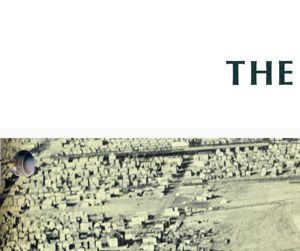
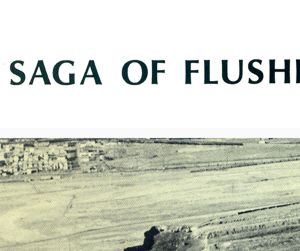
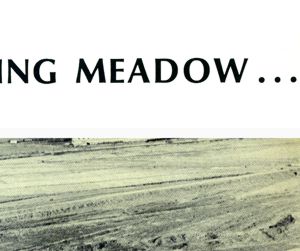
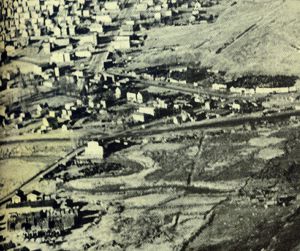
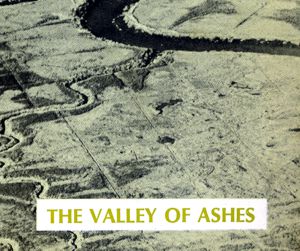
The Town of Flushing, founded in 1645, lies on the east bank of the Flushing River at the head of the Bay. Flushing Meadow is west and south. Geologically speaking, Flushing Meadow had its origins in the scissorlike glacial terminal moraines which cross just above the Meadow and the Sound between the end of the big glacier and the mainland. Flushing Meadow drained nicely until they began to put concrete and house foundations in place of trees and topsoil. It was once a beautiful tidal basin, where farmers and townspeople harvested crops of salt hay, fish, crabs, clams, oysters and wild water fowl. For two and a half centuries the Meadow changed little. Then came Fishhooks McCarthy and his Brooklyn Ash Removal Company, and the once beautiful Meadow became the gigantic ash dump of Scott Fitzgerald's "Great Gatsby".

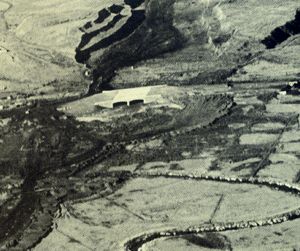
START OF GRAND CENTRAL PARKWAY THROUGH MALODOROUS DUMPS
GCP circa 1930s

"The Great Gatsby" was a gaudy tale about a racketeer who tried to break into North Shore Long Island society in order to be near a woman with whom he had enjoyed a fleeting romance. The main scenes of action were on an estate where Gatsby's prodigal hospitality was enjoyed by hundreds who did not even know his name, and at a filling station in the Corona dumps, through which the Long Island trains passed on their way to greener pastures.

Fitzgerald's description of the dump cannot be improved on even by those of us who knew not only its threatening and depressing outward appearance, but even its exact chemical and physical properties, its unsavory history and the mountainous labors required to take it away.

Said Fitzgerald

"About half way between West Egg and New York the motor road hastily joins the railroad and runs beside it for a quarter of a mile, so as to shrink away from a certain desolate area of land. This is a valley of ashes -- a fantastic farm where ashes grow like wheat into ridges and hills and grotesque gardens; where ashes take the forms of houses and chimneys and rising smoke, and finally, with a transcendent effort, of ash-gray men who move dimly and already crumbling through the powdery air.

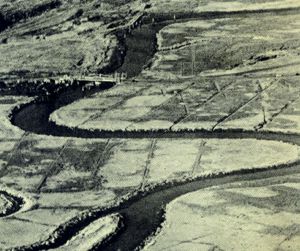
CORONA DUMPS 1933
 Corona Dumps

"Occasionally a line of gray cars crawls along an invisible tack, gives out a ghastly creak and comes to rest, and immediately the ash-grey men swarm up with leaden spades and stir up an impenetrable cloud, which screens their obscure operations from your sight . . . .

"The valley of ashes is bounded on one side by a small foul river, and, when the drawbridge is up to let barges through, the passengers on waiting trains can stare at the dismal scene for as long as half an hour."

"The Great Gatsby" remained a good yarn even after the depression had leveled off the moraine of gold deposited on the North Shore in the delirious twenties. Let us turn now to the steps by which the Corona dump was leveled to make a site for two World's Fairs, and after them the great Flushing Meadow Park of the future.

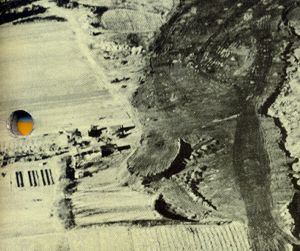
FLUSHING MEADOW PARK 1934
Flushing Meadow Park circa 1934

The new Grand Central Parkway had to run through this wasteland, in which were buried thirty years of the offscourings, tin cans, cast-off baby carriages and umbrellas of Brooklyn. It seemed for a while as if the best we could do would be to obtain a reasonably wide ribbon, fill in part of the meadow and cut through the middle of the dump, leaving two great mountains of refuse which we fondly hoped to cover with a thin layer of topsoil and to plant, at a price which would not subject us to indictment. We studied every possible means of acquiring the whole meadow, but this dream seemed too big for the vision and means of the City in the face of competition of so many other urgent enterprises.

Then the miracle happened -- the idea of a World's Fair. It was not, as is usually the case, a concept of those who have taken the credit for it. It was merely a gleam in the eyes of two quiet, unheralded and comparatively uninfluential gentlemen who met casually in a tavern in Kew Gardens, whose thoughts were put into words by a young girl in high school, the daughter of one of them. It was Joseph Shadgen, a Belgian engineer, whose young daughter acted as a sort of interpreter and public relations agent for him. The other was Colonel Edward Roosevelt, a relative of the Hudson River Roosevelts, who had lived for a long time in France and had worked in many parts of the world.

These two men and the little Shadgen girl, between and among them, hashed up the idea of a World's Fair at Flushing Meadow, and they sold it to George McAneny, a bewhiskered leading citizen, who in turn sold it to me to sell to Mayor LaGuardia. I told Mr. McAneny that I would stop at nothing to help him and Grover Whelan, who became President, if the Fair were actually to be in Flushing Meadow, and if from the beginning the project was planned so as to insure a great park in the geographical and population center of the City.

NEW YORK WORLD'S FAIR 1939-40
1939-40 World's Fair 

The first World's Fair blossomed, received official, public and financial approval, and we got the project under way with a complicated program of basic improvements, financed with City, State, and Fair money, and directed by a distinguished committee. We drove what appeared to be a tough bargain with the Fair, based on division of ultimate profits. Flushing Meadow Park was to received a total of $4,000,000. This proved to be wooden money because there was a deficit instead of a balance, and our source of future development fund simply evaporated. In 1939 and 1940 the Sainted Fiorello LaGuardia, yclept "Frellio" by Governor Smith, established a branch of the Mayor's office in the City Building at Flushing Meadow, emitted admonitions, roars and sharp staccato barks to his constituents, running City hall by remote control and doing it well.

Let me give a rough picture of the scope of this program. It began with the leveling of the great ash dump, filling a considerable part of the meadow, creation of two lakes north of the filled land, building of new approaches, boundary and intersecting traffic arteries, reclamation of the south shore of Flushing Bay, elimination of sewage pollution in the Bay by the construction of disposal plants with trunks leading to them, bulkheading and riprapping of the Bay front, construction of a permanent boat basin, building of permanent utilities for the park and temporary utilities for the Fair, manufacture of topsoil out of earth, peat moss and mulch, planting of large trees, grass and shrubs on the basis of the final landscape design, and an endless number of other basic improvements, not to speak of permanent buildings, such as the City Building, planned for ice and roller skating after the Fair, the State Amphitheater for swimming, concerts and shows when the Fair ended, and other structures.

The total cost of these permanent improvements reached the staggering figure of $59,000,000. Other great permanent public works some distance from Flushing Meadow were in a very real sense by-products of the Fair -- the Bronx-Whitestone Bridge, the Queens-Midtown Tunnel and the removal of the Riker's Island ash dump to build LaGuardia Airport, an achievement which started Bill Somervell on his meteoric rise from Lieutenant Colonel to four star General. It was obvious that the final program for Flushing Meadow park and the parkway and expressway system would take a long time to carry out, and that after all the temporary buildings of the Fair had been removed it would take years to finish Flushing Meadow Park. The war intervened and for a time stopped work.

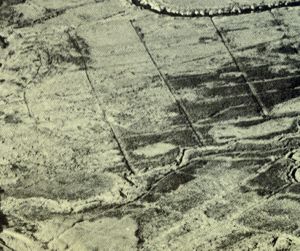
FLUSHING MEADOW PARK - 1945 (INSET: UN AT THE CITY BUILDING - 1946)
Flushing Meadow circa 1945

Then in 1946 came the United Nations and the opportunity to convert a substantial part of Flushing Meadow into the World Capitol. An impressive committee, which included such men as Frederick H. Ecker, Nelson A. Rockefeller, Thomas J. Watson, Winthrop W. Aldrich, John W. Davis, James A. Farley and Arthur Hays Sulzberger, offered this program, but it was finally rejected in favor of a small site in Midtown Manhattan on the East River. Those of us who were connected with the Flushing Meadow Committee, however, kept on. The architects and engineers, led by Wallace K. Harrison, became identified with the new site and its approaches, and much of the preliminary work done to attract the United Nations to Flushing Meadow proved in the end to be valuable on the East River. At the same time it was agreed with Trygve Lie and his associates that the City Building at Flushing Meadow would be converted into an Assembly Hall for annual meetings of the United Nations from 1946 to 1950 until the new Capitol was completed.

PROPOSED WORLD CAPITOL IN FLUSHING MEADOW PARK - 1946
 Proposed UN Building

The U.N. occupancy gave us an opportunity to carry out a substantial part of the park program in the vicinity of the City Building once dominated by the Trylon and Perisphere. West of the City Building and the Grand Central Parkway, and across the bridges of Wheels and Wings, in the area where the transportation exhibits, Courts of Railways and Wheels, were located, a considerable part of the ultimate park program was carried out.

East of Flushing Meadow we added to the park system the so-called Kissena Corridor, a swampy valley leading from Flushing Meadow Park through Kissena Park to Cunningham Park. The opportunity to acquire this corridor arose through the construction of a great storm water sewer. We used sanitary material for fill. The trunk sewer is now completed. Many play fields, walks, basic paths and other recreation facilities have been installed and Flushing Meadow has thus become part of a continuous park and parkway belt extending along the entire north side of Queens to the city line. Grand Central Parkway itself, which was temporarily paved between Horace Harding Boulevard and the Kew Gardens Loop, was widened and the roadway system in the Loop revised as an extension of the Van Wyck Expressway to connect the parkway system with the South Shore and Idlewild Airport.

Soon people with short memories and no conception of the really prodigious difficulties in the way of a program of this scope began complaining that Flushing Meadow was going back to its primitive condition as a haunt of rabbits, foxes and possums. Patience, I kept repeating, patience, my fine critics, patience! Keep your shirts and shifts on! You were not conspicuous when we leveled the ash mountains, and rats big enough to wear saddles, with white whiskers a foot long, gazed wistfully at the bulldozers and junkies who disturbed their ancient solitary reign.

Came the night when the New York World's Fair of 1939-1940 closed. One night late in the Fall they put out the blazing lights in The World of Tomorrow. The following morning the wrecking crews arrived. 44,931,681 visitors had attended World's Fair One. Soon old men and women were telling their grandchildren what the great Corona dump looked like in the days of F. Scott Fitzgerald, how big the rats were that ran out of it, what a volcano there was over on Riker's Island, and how it was all changed overnight.

WORLD'S FAIR 1939-1940
World's Fair 1939-40 

More Content