|
Then in 1946 came the United Nations and
the opportunity to convert a substantial part of Flushing Meadow
into the World Capitol. An impressive committee, which included
such men as Frederick H. Ecker, Nelson A. Rockefeller, Thomas
J. Watson, Winthrop W. Aldrich, John W. Davis, James A. Farley
and Arthur Hays Sulzberger, offered this program, but it was
finally rejected in favor of a small site in Midtown Manhattan
on the East River. Those of us who were connected with the Flushing
Meadow Committee, however, kept on. The architects and engineers,
led by Wallace K. Harrison, became identified with the new site
and its approaches, and much of the preliminary work done to
attract the United Nations to Flushing Meadow proved in the end
to be valuable on the East River. At the same time it was agreed
with Trygve Lie and his associates that the City Building at
Flushing Meadow would be converted into an Assembly Hall for
annual meetings of the United Nations from 1946 to 1950 until
the new Capitol was completed.
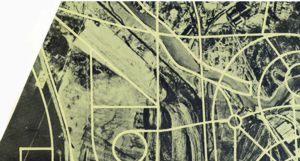
PROPOSED WORLD
CAPITOL IN FLUSHING MEADOW PARK - 1946
 |
The U.N. occupancy gave us an opportunity
to carry out a substantial part of the park program in the vicinity
of the City Building once dominated by the Trylon and Perisphere.
West of the City Building and the Grand Central Parkway, and
across the bridges of Wheels and Wings, in the area where the
transportation exhibits, Courts of Railways and Wheels, were
located, a considerable part of the ultimate park program was
carried out.
East of Flushing Meadow we added to the
park system the so-called Kissena Corridor, a swampy valley leading
from Flushing Meadow Park through Kissena Park to Cunningham
Park. The opportunity to acquire this corridor arose through
the construction of a great storm water sewer. We used sanitary
material for fill. The trunk sewer is now completed. Many play
fields, walks, basic paths and other recreation facilities have
been installed and Flushing Meadow has thus become part of a
continuous park and parkway belt extending along the entire north
side of Queens to the city line. Grand Central Parkway itself,
which was temporarily paved between Horace Harding Boulevard
and the Kew Gardens Loop, was widened and the roadway system
in the Loop revised as an extension of the Van Wyck Expressway
to connect the parkway system with the South Shore and Idlewild
Airport.
Soon people with short memories and no
conception of the really prodigious difficulties in the way of
a program of this scope began complaining that Flushing Meadow
was going back to its primitive condition as a haunt of rabbits,
foxes and possums. Patience, I kept repeating, patience, my fine
critics, patience! Keep your shirts and shifts on! You were not
conspicuous when we leveled the ash mountains, and rats big enough
to wear saddles, with white whiskers a foot long, gazed wistfully
at the bulldozers and junkies who disturbed their ancient solitary
reign.
Came the night when the New York World's
Fair of 1939-1940 closed. One night late in the Fall they put
out the blazing lights in The World of Tomorrow. The following
morning the wrecking crews arrived. 44,931,681 visitors had attended
World's Fair One. Soon old men and women were telling their grandchildren
what the great Corona dump looked like in the days of F. Scott
Fitzgerald, how big the rats were that ran out of it, what a
volcano there was over on Riker's Island, and how it was all
changed overnight.
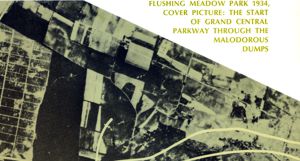
WORLD'S FAIR 1939-1940
|
|