The Electric Power Companies "Tower of Light"

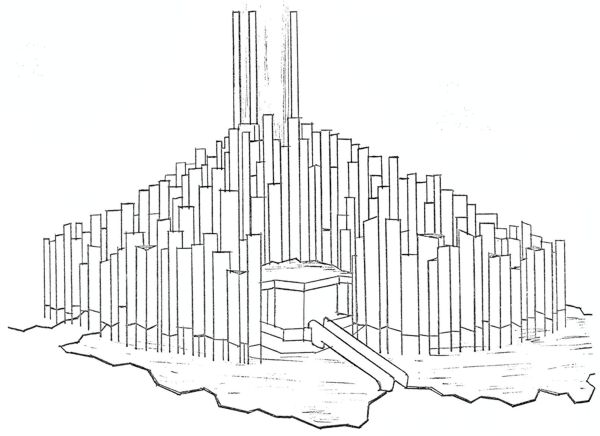
Artist's rendering of the Electric Power Companies' Tower of Light

SOURCE: Commercial Transparency by Photo Lab, Inc., Washington, DC

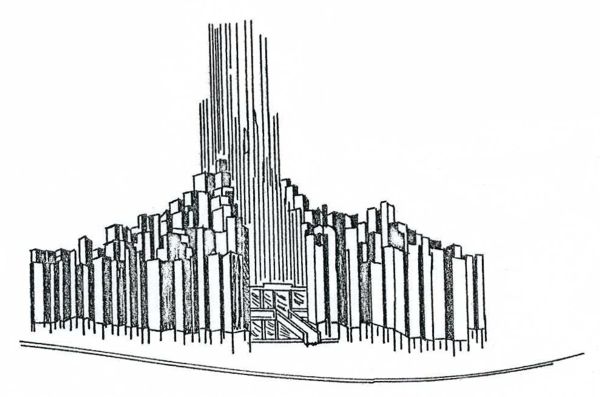
Artist's Rendering

Source: Commercial Transparency by Photo Lab, Inc., Washington, DC
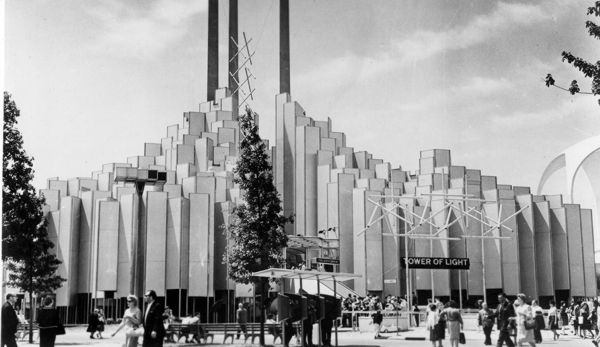
Source: Courtesy Larry Hubble
Tower of Light


Our exhibit building is a sort of pavilion of light prisms in an irregular pattern -- resembling a Gothic "Cathedral of Light" -- rising to a height of 80 feet and crowned by three vertical pylons rising another forty feet. The pylons will frame a super-brilliant shaft of light rising from a mass of searchlights within the central core of the building. This searchlight core will be visible to visitors through a vertical opening in the building as they approach the entrance and of course the shaft of light above the building will be visible from the surrounding countryside for many miles.

The vertically staggered triangular prisms are metallic shells, the exterior surfaces of which will be fluted with thin vertical fins of multi-colored metal so that as a visitor walks past the building in the daytime, it will appear to change color.

In addition to the brilliant tower of light after dark, the building will be bathed in colored lights. Once inside the building the Fair visitors will be carried through a dramatic show on an elevated revolving ring and will exit by a spiral ramp leading them past the core of the tower of light.

Ernest A. Acker, chairman of the Edison Electric Institute's World's Fair Committee in remarks made at the Groundbreaking Ceremony for the Tower of Light, Wednesday, September 26, 1962.

Groundbreaking for the Tower of Light

Robert Moses & Ernest A. Acker break ground for the Tower of Light

I think I can say without exaggeration or hyperbole that this is really a wonderful building. Ordinarily I am not very keen on buildings that are built from outside in as compared to inside out. We have too many buildings that are simply monuments to the architects. But this is a beautiful building and you have room inside for everything you want to show. It will not only be attractive in the daytime, as Mr. Acker pointed out, but will be stunning at night.

I am not going to attempt to evaluate or compare the sciences with the humanities -- we could argue about that till the cows come home. There are people who want to spend all their time discussing why we don't devote more time to the humanities, the arts and all that kind of thing. We are devoting time to them. But what impresses our competitors most is this sort of thing, this sort of an exhibit. It is what we have done in the electrical field and what we have done in science which are, I am sure, the subjects to which the Russians are going to address themselves when we find out [if they will exhibit at the Fair.] They are impressed by this kind of thing; not by many other things we do, some of them good. They simply don't care about them.

We are grateful to you for coming here. you are going to have our cooperation and I am sure this exhibit is going to be one of the great shows of the World's Fair.

Robert Moses, President of the New York World's Fair Corporation 1964-1965 in remarks made at the Groundbreaking Ceremony for the Tower of Light, Wednesday, September 26, 1962.


Source: Edison Electric Institute Bulletin, Summer, 1964

 The "Tower of Light" -- an Amazing Tribute to the Entire Industry

GARLAND S. LANDRITH, JR. is Vice President and General Manager of Electric Power & Light Exhibit, Inc., the corporation set up to administer the investor-owned electric utility companies' participation in the N. Y. World's Fair. Here, with the editor of the EEI BULLETIN, Mr. Landrith talks about that participation.  
Garland S. Landrith, Jr. photo

Q: Mr. Landrith, considering the budget for the exhibit and show at the Fair, do you think it is a good investment for the investor-owned electric utility industry?

A: From our knowledge of other major exhibitors' expenditures, we believe participating companies are receiving a good value per dollar of their investment in this show. We have an imaginative building and an excellent show.

Q: Just how many companies are presenting the "Tower of Light?"

A: One-hundred-and-forty-nine.

Q: How did each company contribute?

A: Each contribution was voluntary and based on the total number of electric meters and distance of the company from New York City.

Q: What is the over-all budget for the industry's participation in the Fair?

A: The total resources available for the project were in the neighborhood of $9 million. Considering the high cost of construction and installation at the Fair, this seems to be a reasonable expenditure for this excellent World's Fair presentation.

Q: The pavilion is radically different from many other buildings at the Fair. There are countless domes and "boxes" housing exhibits there. Why was this particular type of building selected?

A: It was our intention to have an integrated design of both building and contents, not merely a building with the show designed to fit the structure. The designers approached our objective with this idea in mind, and proposed a concept of a building of prisms similar to light prisms which would contain the Tower of Light searchlights in the central core and a show presented in the chambers formed by the prisms.

Q: You mean the building was designed specifically with the electric utility industry in mind?

A: Absolutely. The physical shape should suggest to the visitor, either consciously or subconsciously, the electric power and light industry.

Q: Has the building "caught on" with the public?

A: Our building has had an excellent reception with the press, with dignitaries who have visited it, with architects and engineers, and with the general Fairgoers. At night, during ceremonies when the floodlights and searchlights are turned on, there have been many instances when the visitors burst into applause. I've heard people say it is the most imaginative and most beautiful pavilion at the Fair.

Q: I've seen the Tower of Light featured on national news programs, on national variety programs, in national magazines, in newspapers all over the country, and on posters in airline offices and in subways. How does the publicity for the industry's building rank with that of other pavilions?

A: It is my opinion that we have received more favorable publicity than most exhibitors spending many times as much money. This I attribute to the effectiveness of our public relations program, which relies basically upon the extensive activities of the sponsoring companies throughout the country. These sponsoring companies have been successful in creating interest in their areas. In fact, the public relations staff of the World's Fair Corp. has repeatedly expressed its appreciation for what these companies have done.

Q: When did the industry first take action to exhibit at the Fair?

A: In the late summer of 1960. Our site was reserved in September, 1960.

Q: What was the first step in getting the project started?

A: The Institute formed a World's Fair Committee of 17 chief executives of member companies from all parts of the country to consider the project from and industry point of view. This committee recommended that the industry participate. Ernest R. Acker, who at the time was Chairman of the Board of Central Hudson Gas and Electric Corp., was chosen as Chairman of the World's Fair Committee. Mr. Acker is widely known throughout our industry, and is a past president of EEI.

Q: The Tower of Light is not the original building planned for the industry. I remember seeing a photograph of an artist's conception of another building, which was different from the one finally chosen. what prompted the change in design?

A: The original building concept was not integrated with the interior exhibits.

Q: How did you select the final designers?

A: The EEI World's Fair Committee screened about a dozen designers. Their objective was an imaginative team to present an integrated industry story. From various sources, they obtained the names of industry designers both large and small. After a thorough screening, and checking with experts on World's Fair projects and exhibitions, they finally decided upon Robinson-Capsis-Stern Associates, Inc., who made a presentation to the World's Fair Committee in 1962, and whose concepts were accepted at that time.

Q: I visited the Tower of Light several times while it was still in the final stages of construction, and was there on the night the lights first were turned on. I found nearly all the people concerned with its construction extremely enthusiastic about the building. Was this enthusiasm evident throughout the construction period?

A: It certainly was, and increased after we made a presentation to all of the construction people, explaining the entire concept of the building and the show which would take place inside each chamber. I believe this created a good deal of enthusiasm for the entire project.

Q: How long was the pavilion under construction?

A: About 17 months after breaking ground on September 26, 1962.

Q: Just where is the Tower of Light located, and what is the best way for people to get there?

A: The Tower of Light is situated just off the Pool of Industry, where the giant fountain is located and the fireworks display takes place each night. It is at the corner of the Avenue of Commerce and Dwight D. Eisenhower Promenade. the Avenue of Commerce is the main thoroughfare from World's Fair Gate No. 1, which is the entrance from the subway and the Long Island Railroad, either of which is an excellent way for people to get to the Fair.

Q: In 1963, a series of regional meetings was held throughout the country to familiarize the sponsoring companies with the Tower of Light and the show. Just what was the extent of these briefings, and were they successful?

A: We held eight regional meetings, beginning in Dallas in May and concluding in New York in June. We also met in Atlanta, Los Angeles, Spokane, Chicago, Cleveland and Boston. They were successful in accomplishing the objective of finding out from the member companies suggestions for improving our contemplated publicity and public relations program. They were successful in generating interest among the companies in the project, and thus enabling them to incorporate material about the exhibit into their local publicity, advertising, and public relations programs.

Q: Do you think there will be as much enthusiasm about the Fair during its second season as there is now?

A: If the local companies continue the excellent efforts that they have been devoting to the project to date, there is no question but our second season can be as enthusiastically received as the first.

Q: What will happen to the staff and the pavilion during the winter, after the Fair closes its first season?

A: Naturally the operating elements will close. However, a great deal of cleaning and maintenance work will be required in order to prepare our exhibit for the opening on April 21, 1965.

Q: You have this magnificent building, erected at a cost of several million dollars. When the Fair is over, what will become of the building?

A: As with all exhibitors, our lease with the Fair provides that it be torn down. However, we have had a number of inquiries -- from persons in Florida and California, and from the Governor of North Carolina -- who have expressed an interest in moving and reconstructing the building in their areas for exhibit purposes. But we have accepted no offer yet.

More Content