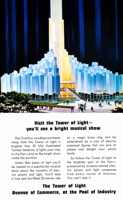
Stories of the Tower of Light 

"Alply"aluminum panels

"Tower of Light" Pavilion Covered with "Sandwich-Type" Aluminum

A "SANDWICH-TYPE" of aluminum paneling -- in effect an inner wall, an outer wall, and a core of insulating material all in one piece -- covers the exterior of the investor-owned electric utility companies' pavilion at the World's Fair.

Manufactured by Aluminum Co. of America, the panels -- called "Alply" -- are in a natural "Alumilite" finish.

More than 1200 of these panels -- up to 18 feet in length and just over 4 1/2 feet wide -- were used to cover the building. If laid end-to-end, they would extend for more than two miles, and represent one of the world's largest applications of Alply.

The "Tower of Light" designers and architects chose the Alply panels because of aluminum's reflective qualities, its adaptability to the radical design of the tower, its light-weight, load-bearing features, outstanding insulating factors, and ease of erection and maintenance.

The revolutionary, circular Atomedic Hospital, which is serving as the official hospital for the Fair, also is walled with Alply. In this case, the aluminum sandwich panel permits the hospital to be easily shipped -- even by plane -- and quickly erected or dismantled.

Although only a few homes have been constructed of these panels, the potential is promising. A new development by Alcoa is the "snug seam" method of joining the panels by forcing a neoprene gasket between them. The joining action closely resembles zipping the panels together. the panels of the Tower of Light pavilion were joined by this method.


 Giant "Lazy Susan" Takes Fair Visitors Through Industry Show

A GIANT "Lazy Susan" or a large phonograph turntable: both could be descriptions of the solution which has been found to cope with the problem of moving visitors through the Electric Power & Light Exhibit.

It is expected that each day, for the 180 days of both Fair seasons, an average of 17,000 people will come to view the show. A way had to be devised to keep the flow of traffic moving at a comfortable and convenient speed.

Macton Engaged

To meet this need,
EP&LE engaged the Macton Machinery Co. of Stamford, Conn. to construct and install a unique revolving magic carpet. Said to be the second largest such ring ever built, it has an outside diameter of 108 feet, and an inside diameter of 78 feet. Visitors are transported to the turntable via a moving ramp, embarking on a seven-stop tour of The Enjoyment of Electricity. At top capacity, this moving stage will carry 30,000 people a day through the "Tower of Light."

Powered by a 15-horsepower motor, the ring operates on a principle similar to a phonograph turntable. As far as it is known, this is the first time a turntable has been built with controlled acceleration and deceleration. It starts slowly, and then goes at a constant speed, with stops at regulated three-minute intervals.


Friction drive unit for TOL's turntable

The friction drive unit which operates the Macton turntable inside the "Tower of Light" is shown above. Its operation is much like that of a phonograph. For smooth starting and stopping, this turntable has controlled acceleration and controlled deceleration.

Several safety features have been built into the machinery of the turntable. Only one man -- the master controller -- can start it. However, seven attendants, who are located at the seven stations, can stop the moving turntable if necessary.

An entrance and exit gate -- two additional safety features -- have also been constructed. These are two curved gates running parallel to the curvature of the ring. They operate very much like curved sliding doors. When the turntable has come to a complete stop, it will hit a limit switch, automatically opening the gates. The attendant will then let a given number of people in, press a button, close the gate, and start the turntable. The revolving ring cannot be set in motion unless the gates are closed.

TOL's turntable under construction

The turntable for the "Tower of Light" show is assembled, above, by Macton Machinery Co., in Stamford, Conn. In the photograph below, the track for the turntable is being erected at the pavilion. This is the second largest such turntable at the Fair. Visitors to the Tower of Light pavilion are transported through the seven chambers of the show on this turntable.

Turntable installation inside the Tower

 "The Enjoyment of Electricity"

By Alfred Stern

President, Robinson-Capsis-Stern Associates, Inc.

IN 1962, I produced and co-authored The Threshold and the Threat, the theme show for the Seattle World' Fair. On the opening day of that exposition, some 43 pounds of Edison Electric Institute and other industry institutional literature arrived at my Seattle hotel for, prior to leaving New York, our firm (Robinson-Capsis-Stern Associates, Inc.) had been retained to design and produce the Electric Power and Light Exhibit's pavilion and show for the New York World's Fair. Needless to say, I did not take time out on the opening day of the Seattle Fair to read this prose. I must confess that I have read precious little of it since for, as a script writer and producer, I felt that my prime mission was to create a show which would communicate successfully to and entertain those who are not intimately acquainted with the complex technology of America's electric utility industry. I have found this premise valid in the past as, while I have done three or four major productions for the U. S. automotive industry, I do not drive.

 
"Uncle" Ben Franklin

"Uncle" Ben Franklin -- star of EP&LE's "Enjoyment of Electricity"

Objectives Analyzed

I did, however, carefully analyze the objectives of the investor-owned electric utility industry, and became convinced that, while these objective were valid, the techniques of communication must be totally different from the vast majority of intra-industry communications and promotions. We are, at the Fair, speaking for the most part to American families who come to Flushing Meadow in a festive mood. This led to the conclusion that one must combine the theme of the industry's progressive technical expertise with its dedication to free enterprise.

These two elements, while impressive institutional themes, do not, in themselves, make for festive entertainment and, therefore, it became essential to develop characters who -- or which -- as we are full of animals . . . could best express the twin themes of technical ability and dedication to free enterprise.

Concept of Pavilion

Even before conceiving a script and production treatment, we addressed ourselves to the concept of the pavilion itself, which we felt must accommodate the largest possible capacity for a presentation of less than a half-hour duration (with all the myriad attractions at the Fair, spectators resent being detained in any single exhibit for more than a half-hour, and their attention-span is of limited duration). It has always been our philosophy that a successful Fair pavilion must not only function successfully in regard to capacity and traffic circulation, but, of even greater importance, must not resemble architecture which Fair visitors are likely to encounter in their home town. If a Fair pavilion looks like a bank, airport terminal, or an aluminum and glass shoe-box office building, it is doomed to failure.

We were convinced that the Tower of Light should extend its specific theme, and therefore developed a pavilion of prisms which express the soaring verticality of light, changes color, through the use of mirrored reflectors during daylight hours and through the use of programmed colored illumination after dark, cascades upward toward the central Tower of Light, and emotionally is indeed a cathedral of light, in which the 12-billion candlepower Tower of Light becomes a central shrine.

Richard Hedman, formerly of our staff, played an important role in the development of this initial concept, and we were fortunate in our association with Synergetics, Inc., our architects and engineers, in its practical realization. Synergetics, headed by James Fitzgibbon, was founded by Buckminster Fuller, the famed innovator of the geodesic dome.

Early in the development of The Enjoyment of Electricity, I conceived a rotund light-bulb character called "Uncle Ben," reminiscent of an earlier Ben named Franklin, an important contributor to electrical technology and a champion of free enterprise, for our protagonist must express both our themes of electrical ingenuity and free enterprise. The entire script for such a half-hour presentation runs somewhat under 3600 words (for without any pauses for musical and visual effects one can say only 120 words a minute), scarcely longer than a night letter home. Certainly in 3600 words we cannot go into great technological detail. I was dedicated to the conviction that we could not produce a 30-minute commercial, as after paying a $2.00 front-gate admission (adults) or $1.00 (children under 12), visitors would, with complete justification, resent being trapped in a costly edifice which would merely say in pompous terms, "Look what a good boy am I!"

Uncle Ben carries the broad, free-enterprise philosophy of the investor-owned electric utility industry, but the sponsors insisted that the script be peppered with a great deal of factual and statistical information. any such information must be presented in brief, entertaining terms if it is to communicate successfully. So we developed a sidekick for Uncle Ben. At first he was a wire dachshund: smart, and sharp, and with the ability to stretch the length of any show chamber in the pavilion. But later he was changed and became "Sam the Eagle," a somewhat brassy, no-nonsense bird, which finds Uncle Ben's philosophy insufficient unless it is supported by factual statements.

Problems of Sam

Sam, the Eagle, in turn, presented problems. Some people felt that he was too authoritative, but his contrast with Uncle Ben's broad philosophy gives The Enjoyment of Electricity a bit of conflict and bite, which is the essence of any theatrical experience.

A script began to evolve. New characters emerged: the kangaroo, to symbolize the high cost of living (which is indeed jumping higher all the time); the cheerful "Kilowatt Birds," to symbolize the services, enterprise and economy of the investor-owned electric utility industry; a series of barnyard animals -- a languorous cow which finds that electric milkers are ever so much more pleasant than "Farmer Brown's icy hands", -- two premium piglets, which go to market sooner because they eat all day and night due to electric illumination, and three chickens, grateful to their electric incubators and brooders; a penguin, proud of the accomplishments of electric air conditioning; a polar bear who understands that electric air-conditioning is ideal for hibernation, and a mermaid who realizes that electric air conditioning means you can control the temperature and achieve an ideal climate for, as she says, "Families spend more time together when they can control the weather."

Though the subject matter was inevitably somewhat technical, it was our concept that it should take the form of a light-hearted musical revue.


 "Tower of Light" Beacon Produces 12 Billion Candlepower

AMONG the millions of lights that are attracting unprecedented crowds to the hundreds of exhibits at the New York World's Fair every night, there is one beam that thrusts through the skies for an indeterminable distance with the intensity of more than 105 million 100-watt lamp bulbs.

This beam emanates from the Tower of Light Court in the pavilion of the investor-owned electric power and light industry. It is the biggest concentration of exposition lighting in the world. At peak brightness, each of the 12 beams is approximately three times as bright as the surface of the Sun.

12 'Xenon' Arc Lamps

For the central beam at the Tower of Light exhibit, General Electric Co. provided a bank of 12 "Xenon," short-arc lamps, each with an intensity of 1.08 billion candlepower. GE developed the 5-kw Xenon lamps for solar simulators in space research.

The visibility of the lights depends on atmospheric conditions, especially the height of cloud layers.

The intensity of the beam can be realized by the fact that a typical good reading lamp produces 50 footcandles of illumination on the printed page held at a comfortable distance under it. The beam from the Tower of Light produces the same illumination at a distance of five miles.

As another example, Chicago's State Street, the brightest lighted street in America, has an illumination of 15 footcandles. The Tower of Light beam produces the same illumination at 5.6 miles.

The beam is 18 feet in diameter at 1500-foot altitude, 30 feet at 2500 feet, and 43 feet at 3500 feet.

The bulbs, which have quartz jackets, are 3 1/2 inches in diameter and 19 1/2 inches high. the cathode and anode material is tungsten, and the arc gap is 8 mm. Each of the 12 Xenon lamps is positioned in the center of a 60-inch parabolic reflector.

These short-arc lamps reach full brightness almost immediately after the arc is struck. Instantaneous restarting is possible.

Engineers from General Electric and T. F. Jackson, the wiring and engineering sub-contractors, installed the lights in five weeks.


Source: Edison Electric Institute Bulletin, various, (all above)

 Exterior Illumination of "Tower of Light" Creates a Man-Made Aurora Borealis

ALL the hues in the rainbow in a constantly changing pattern on the exterior of the industry's World's Fair pavilion -- which is centered by the 12-billion candlepower beam -- and reflected in the surrounding pool, present a dramatic spectacle unparalled at the Fair.

Using colored gelatin sheets in light fixtures, as well as color-coated bulbs, the designer has arranged the lighting to vary from the rich primary colors to subtle shades of blues, greens, reds, ambers, yellows, and pinks. An almost infinite number of combinations of tone, hue and intensity results as the colored lights glow and fade against the metallic prisms of the building's facade, creating a man-made aurora borealis. The programmed lighting consists of 14 independent circuits of various sizes and colors of lights. Each circuit has a timer to control the duration of the circuit's illumination.

Large Model Used

A large model for the "Tower of Light" was used to work out the positioning of lights for the exterior.

More than 100 1500-watt, quartz-iodine floodlights surround the building to light its lowest level. They are covered by multi-colored filters and are directed on the facade from across the reflecting moat. cycle timers automatically vary the predominantly blue and green color tones on the lowest level of the structure.

Rows of concealed colored lights in two of the three pylons at the apex of the pavilion illuminated the Court of Light and "Photonium," the Snelson sculpture suspended from the pylons.

The spectacle of light, which the World's Fair visitor sees (via the 12-billion candlepower beam) as he nears the Fair grounds, and which is intensified as he approaches the pavilion, is continued inside the exhibit. The lighting for The Enjoyment of Electricity includes a Fourth of July celebration scene with "fireworks" created by electricity, a thunder and lightning scene in the "Overture of Light," and a Christmas scene with gaily lighted ornaments.

The interior lighting of the lounges and waiting rooms deliberately has been made soft and restful, in contrast to the lighting spectacle of the pavilion's exterior and seven-chambered show.


 View-Master packet

VIEW-MASTER INDUSTRIAL AREA, New York Worlds Fair 1964-65, Sawyer featured the "Tower of Light" on the cover of their Industrial Area View-Master packet.

More Content