|
-
- "
|
- I believe that
- man will not
merely endure:
- he will prevail."
-
- William Faulkner
|
|
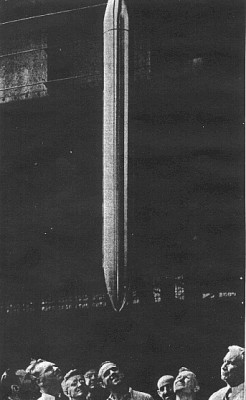
- Poised against
the Long Island sky, high above an open air pavilion is suspended
a slim metal tube - shining proof that man endures and indeed
prevails.
-
- Positioned there
is a silvery duplicate of the Westinghouse Time Capsule of the
1964-65 New York World's Fair. The torpedo-shaped capsule will
carry a message 50 centuries into the future heralding man's
unprecedented progress during the past 25 years.
-
- Visitors passing
through the pavilion pause at exhibits and ponder what they would
select for this incredible journey. What best records the follies
and fortunes of our times?
-
- "The formation
of the United Nations," offers a well-dressed housewife
from Ohio.
-
- "A filmed
record of World War II," candidly remarks a gray-haired
lumber dealer from Maine.
-
- "A Beatles
record," quips a sun-burned teenager from California.
|
|
- Off-hand remarks
like these typify the myriad opinions that Fair visitors register
as they parade through the Westinghouse Electric Corporation
pavilion. And centered above them, spurring imaginations, is
the Time Capsule, dramatically suspended 50 feet in the air from
three 100-foot pylons. At the conclusion of the Fair, the Time
Capsule will be buried beneath the site, to be unearthed 5000
years from now. Like its sister entombed 10 feet away -- the
famed Westinghouse Time Capsule of the 1938-39 World's Fair --
Time Capsule II will bring up to date the chronicle of the "history,
faiths, arts, sciences and customs" of our civilization.
-
- If Time Capsule
II represents many things to many people today, imagine what
those excavators in 6939 A.D. will think when they discover our
metal shells and this legacy we have left behind.
-
- Travelers to
the Westinghouse pavilion record their names for reproduction
on special miniaturized microfilm that will be slipped into Time
Capsule II before it is sealed, thus preserving a genealogical
record for descendants 150 generations from now. But names are
secondary; what should we leave that
|
Beginning
its 5000-year sleep, the 1938 Westinghouse Time Capsule was lowered
into its resting place in the historic scene shown here. The late
Grover A. Whalen (right), then president of the New York World's
Fair, and A.W. Robertson (left), then Westinghouse Chairman of
the board, watched the capsule being lowered.
 |
|
- best mirrors
the progress of those remarkable years since the days of the
Trylon and Perisphere.
-
-
- From Dawn
to Now...The Task Begins
- That question
faced Westinghouse a quarter of a century ago as it embarked
on the historic first Time Capsule project.
-
- Let us go back
to 1938 and the Westinghouse Time Capsule I. Begin first by selecting
a jury. Their task: Select the legacy.
-
- Wading through
piles of suggestions the committee assembled a varied collection
of historical material that would effectively document our civilization
a it was in 1938. Archaeologists in that unimagined future may
be puzzled by what they uncover but in 1938 this material reflected
civilization as it paused briefly at a world's fair in New York
City.
-
-
- A Woman's
Hat and a Slide Rule
- Tourists to
the Fair today are amused by some of the articles on display
in one of the three exhibit areas
|
The
contents for the 1938 Westinghouse Time Capsule were checked at
the company's lamp division in New Jersey where the first capsule
was packed for its journey. Objects ranged from an alarm clock
to a baseball.
|
|
|
- at the Westinghouse
pavilion. Twenty-five years of accelerated living suggest the
inevitable ... "Is that how we were then?"
-
- How we were
"then" is represented by dozens of articles of common
use ranging from a woman's hat to an engineer's slide rule but
not excluding a safety pin, a can opener, and a toothbrush. Also
on exhibit is a listing of 75 examples of such representative
materials as fabrics, metals, plastics and a variety of seeds.
Into Time Capsule I went these materials along with 35 articles
of common use. Also encapsulated were brief messages addressed
to the future from scholars like Dr. Albert Einstein, physicist
and creator of the Theory of Relativity, whose equation E=mc²
was to mean so much in the ensuing years.
-
- "See
What We Did"
- To cram as much
material as possible into Time Capsule I the pages of books,
magazines, newspapers, circulars, catalogs and pictures were
reproduced on three and a half reels of microfilm. And the committee
foresightedly added a small viewer for
|
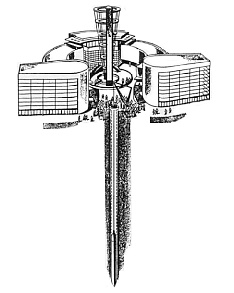
The
diagram shows how Time Capsule II is constructed. The Kromarc
stainless steel capsule contains a glass inner shell which will
provide an air-tight envelope for the capsule contents. On the
right, metallurgist H.D. Greenbert, who supervised construction
of the new Time Capsule, gives the gleaming torpedo-shaped structure
its final check-out.
 |
|
- reading the
microfilm along with instructions for making a projector. A newsreel
was added to show historic and characteristic scenes of the time
- an address by President Franklin D. Roosevelt and a Miami fashion
show.
-
- And Only
25 Years Later...
- The advent of
another World's Fair and the rush of events since 1939 launched
Time Capsule II. In a quarter of a century, man split the atom,
danced the twist, ran the four-minute mile, scaled Mt. Everest,
fought another World War and began to probe space and the seas.
-
- Dr. Leonard
Carmichael, retired secretary of the Smithsonian Institution
and distinguished chairman of the Time Capsule II Selections
Committee, described the committee's function as "to make
selections to bring the 1938 Time Capsule up to date, and to
aid peoples 5000 years from now in understanding our present
civilization and the rapid pace of progress that we have been
experiencing."
-
- The encyclopedic
chore of selecting contents for
|
Dr.
Leonard Carmichael is chairman of the distinguished 14-man Selections
Committee choosing the contents for Time Capsule II. Dr. Carmichael
is retired secretary of the Smithsonian Institution.
|
|
|
|
|
|
| Three cycloramic
displays in the Westinghouse Time Capsule pavilion at the New
York World's Fair show many of the contents of the 1938 Time
Capsule, progress over the past 25 years, and a 5000-year calendar
of significant events of the |
past. Contents
of Time Capsule II, to be buried October 16, 1965, will be put
on display during the second season of the Fair. The new capsule
is suspended 50 feet above the pavilion from three pylons.
Architect:
Eliot Noyes & Associates
|
|
- the Second Time
Capsule fell to a blue-ribbon panel of 14 Americans whose credentials
are as impressive as their assignment:
-
- Dr. Detlev
W. Bronk, President,
The Rockefeller Institute, and past President, The National Academy
of Sciences
- Dr. Ralph
J. Bunche, Under
Secretary, United Nations, and recipient of the Nobel Peace Prize
- Dr. Vannevar
Bush, Honorary
Chairman, Massachusetts Institute of Technology Corporation,
and former President, Carnegie Institution of Washington
- Dr. James
B. Conant, former
U.S. ambassador and former President, Harvard University
- Dr. Watson
Davis, Director,
Science Service
- Dr. Hugh
L. Dryden, Deputy
Administrator, National Aeronautics and Space Administration
- Dr. John
Kieran, Writer
and Naturalist
- Dr. Henry
Allen Moe, President,
American Philosophical Society
- Dr. Eugene
Ormandy, Music
Director, Philadelphia Orchestra
- Dr. Alfred
Newton Richards, Pharmacologist,
past President, national Academy of Sciences
- Dr. Glenn
T. Seaburg, Chairman,
Atomic Energy Commission, and winner of the Nobel Prize for Chemistry
- Dr. William
E. Shoupp, Vice
President, Research, Westinghouse Electric Corporation
- Mr. Andrew
Wyeth, Artist
|
One
of the bullet-shaped end pieces of Time Capsule II is welded into
place at the East Pittsburgh plant of Westinghouse Electric Corporation.
The capsule is made of Kromarc, a "super" stainless
steel having unusual weldability.
 |
|
- Assisted by
four advisory subcommittees in Europe, Far East-Oceania, Latin
America and Africa-Middle East, the committee's selections will
be on cycloramic display at the Westinghouse pavilion during
the second season of the Fair. Members of the committee are authorities
in such fields as atomic energy, arts and entertainment, commerce
and industry, communications, education, the humanities, how
we live, medicine and health, science, space, sports and recreation
and world events.
-
- As the committee
began its quest, Westinghouse found itself traversing familiar
terrain and matching new technology to solve an old question
- can the capsules last for 5000 years?
-
- Westinghouse
Research Laboratories in Pittsburgh found the answer in a new
super alloy called Kromarc. Exhaustive chemical testing said
this new stainless steel would be an excellent jacket for Time
Capsule II because of its ability to resist corrosion.
-
- Soil samples
from 50 feet below ground at the Fair site in Flushing Meadow
Park revealed that the Long Island soil is almost completely
lacking in chloride ions, a major cause of metal corrosion.
|
J.E.
Paterson of the Westinghouse Research Laboratories examines a
sample of soil taken from 50 feet down in New York City's Flushing
Meadow Park. The soil was given a detailed chemical examination
to determine the exact nature of the 50-century resting place
of the Time Capsule.
|
|
|
- Reports Dr.
F.P. Byrne, manager of the company's Research Laboratories' analytical
chemistry section: "We have concluded that there is little
possibility of severe corrosion of the Kromarc capsule by soil
of such analysis."
-
- The Messengers
- The two capsules
bear many similarities. Time Capsule I was made from a Westinghouse
developed metal called Cupaloy, a copper, chromium and silver
alloy tempered to the hardness of steel. Time Capsule I was cast
in seven sections while the second Time Capsule is constructed
in three parts. The center section was cast by the U.S. Pipe
& Foundry Company of Burlington, N.J. The two bullet-shaped
end pieces were cast separately by Esco Corporation of Portland,
Ore.
-
- As with the
original capsule, the contents of Time Capsule II will be sealed
inside an air-tight glass envelope. Air within the envelope will
be evacuated and replaced by an inert gas that will prevent the
contents from deteriorating. The metal capsule will then be sealed.
Protection of the contents will be insured in much the same way
as was Time Capsule I. In the case of Time Capsule I, the U.S.
Bureau of Standards examined all the materials for durability.
|
Veteran
Westinghouse machinist Carl W. Buehrig machines to final shape
the tubular body of the gleaming Time Capsule II. Machine work
on the capsule was carried out at the East Pittsburgh plant of
Westinghouse.
 |
|
- Care was taken
not to include any objects which might produce fumes or acids
capable of attacking other articles. all liquids were ruled out
and organic objects such as seeds were hermetically sealed in
glass receptacles. Film was placed in aluminum containers and
other objects were individually wrapped in heavy rag paper and
tied with linen twine.
-
- When the packing
of the inner envelope of glass was completed, the air inside
was exhausted, replaced with nitrogen, and enough moisture injected
to equal the humidity found in an ordinary room. Then the glass
envelope was heated and sealed. Finally, the inner envelope of
glass was placed in the metal shell, and the cap of the capsule
was secured to form an airtight seal.
-
- Time Capsule
II will be finally laid to rest on October 16, 1965 - designated
Time Capsule Day at the Fair. The 300-pound tube will be provided
the same survival insurance as its predecessor. Lowered in place,
the seven foot, six inch capsule will be coated with pitch, surrounded
by concrete poured down a shaft and left secure beside its sister
capsule.
|
To
assure that future generations would have the exact location of
Time Capsule I, a "Book of Record" was printed in 1938.
Copies were distributed to safe repositories throughout the world.
A supplement to the "Book of Record," announcing Time
Capsule II, will be mailed to these same locations.
|
|
|
-
SOURCE: Promotional
Brochure distributed to Fairgoers
|
- Permanent
Sentinel
- Above the spot
where the Westinghouse Time Capsules rest, a granite monument
will stand as a permanent sentinel. This memorial, produced by
the Rock of Ages Corporation, says:
-
-
The
Time Capsules
-
Deposited
-
September
23, 1938
-
And
-
October
16, 1965
-
By The
-
Westinghouse
Electric Corporation
-
As A
Record Of
-
Twentieth
Century Civilization
-
To Endure
for 5,000 Years
-
- A Monastery
in Tibet, A Library in Manhattan
- How will the
capsules be found?
-
- Some day 5000
years hence in a monastery in Tibet, or perhaps in a library
in Manhattan, a book will provide the key. The "Book of
Record," printed on permanent paper with special ink, describes
in exact terms the latitude and longitude of the burying place
of the capsules. Some 3,000 copies of the "Book of Record"
are in libraries, museums, monasteries and other safe repositories
around the world. A supplement to the "Book of Record,"
announcing Time Capsule II, will be mailed to these same locations.
-
- In a message
to posterity, the book requests that its contents be translated
into new languages as they supersede the old. Instructions for
making and using instruments to locate the capsules electromagnetically
are included in the "Book of Record." It also contains
an ingenious key to the English language to aid archeologists
of the future should knowledge of our present language be lost.
-
- And Ahead?
- And what of
the years to come? A cure for cancer? Weekend trips to the moon?
-
- No matter to
what great heights we ascend or to what great depths we descend,
we of the Twentieth Century bequeath to the Seventieth Century
proof that man not only endures, but he also prevails.
-
-
|
|
|