|
The New York World's Fair,
being planned for 1964 and 1965, seemed a perfect showcase for
a state's scenic attractions and business opportunities and Wisconsin
took an early interest in the event. A state World's Fair Commission
had been given one of the choicest spots in the State and Federal
Area of the Fair. But by late 1963, with cost estimates for the
pavilion and its operation exceeding a million dollars and with
neither tax nor private funds available for its construction
and operation, the pavilion seemed an impossibility.
Private sponsorship
ensures state's participation
The story of the Wisconsin
Pavilion might have ended right there in 1963 if it hadn't been
for the efforts of Clark Prudhon, president of Pruden Steel Buildings
in Evansville, Wisconsin. When Prudhon learned the state was
about to drop plans for an exhibit at the New York Fair he was
disappointed that the opportunity to exhibit Wisconsin's great
resources would be lost.
So he arranged with John
Steinman, an architect from Monticello, Wisconsin, to design
a low cost structure able to compete in style and unity with
surrounding pavilions at the Fair. The building would be built
with materials and frames provided by Pruden Steel Buildings.
Given a suitable pavilion at a reasonable cost Prudhon was convinced
that other manufacturers in the state would be willing to contribute
to the exhibit. He presented his ideas to the Wisconsin World's
Fair Commission and they were certainly interested!
Source: Presented
Courtesy John Pender Collection
|
|
Just as Prudhon had predicted,
private enterprise did take an interest in the project. Charles
Sanders, a Wisconsin businessman who had been involved with the
Seattle World's Fair in 1962 learned of Prudhon's plan and entered
the picture representing major private financing. Sanders and
Associates would provide financing to build the Pavilion with
the privilege of selling commercial display space to exhibitors.
They would reserve the Pavilion's entry building (called the
Rotunda) for the state's own display and give the state veto
power over any commercial exhibits in the pavilion. Additionally,
the Rotunda building would become the property of the state of
Wisconsin at the close of the Fair.
By now there was so little
time left before the Fair's official opening in April of 1964
that the World's Fair administration nearly denied the Wisconsin
World's Fair Commission permission to build. However, with construction
starting in early 1964, the Wisconsin Pavilion was finally built
at the last minute on one of the prime spots of the Fair.
The pavilion stood just
to the right of the New York City building at the foot of the
bridge crossing the Grand Central Parkway to the Transportation
Area of the Fair and General Motors' Futurama. It was
situated directly across from the New York State Pavilion's observation
towers and the New Jersey Pavilion and "just down the road"
from the Fair's symbol Unisphere. This prime real estate
proved valuable to the pavilion's popularity.
Rotunda is pavilion's
main feature
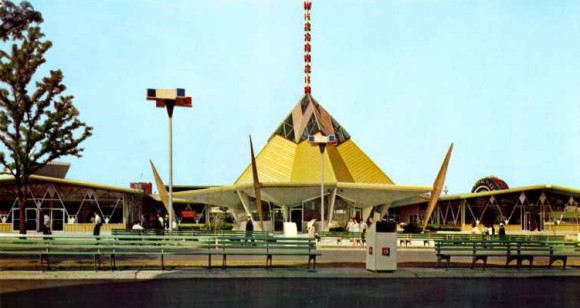
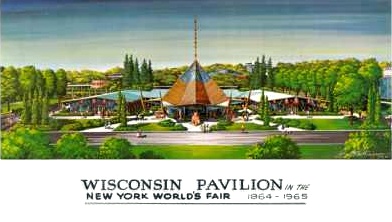
The pavilion constructed
on the Flushing Meadow grounds actually consisted of two structures.
The Rotunda served as an entry into a surrounding U-shaped exhibit
hall housing commercial exhibits and restaurants. The Rotunda
building was 48 feet in diameter with 12 sides. Six star-shaped
canopies supported by gold "light pylons" jutted out
from a roof structure rising to a 60 foot peak. The top of the
Rotunda contained a unique complex of 120 panes of blue and gold
stained glass (the official colors of Wisconsin). Extending from
the roof peak was a 50 foot pole on which were fixed metal letters
spelling out WISCONSIN. Indian inscriptions of mosaic tile were
applied to the base. The surrounding structure complimented the
Rotunda building.
Because of the Prudhon/Sanders
idea no tax dollars were spent for the construction of the pavilion.
However, the state legislature did appropriate monies for the
operation of the pavilion and for a state exhibit within the
Rotunda building. The pavilion eventually cost the state taxpayers
1.5 cents per visitor or approximately $199,000.
Exhibits highlight Wisconsin's
scenic wonders
During the 1964 run of
the Fair the displays in the Rotunda building highlighted Wisconsin's
history, universities, highways, conservation, natural resource
development, aeronautic industry and agricultural and dairy industries.
The U-shaped exhibit hall displayed "The World's Largest
Cheese," commercial exhibits, a trout pond, a cheese booth
and Tad's Steakhouse. 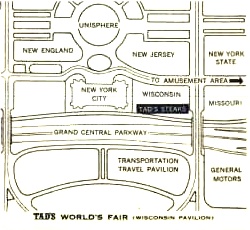 Tad's
proved to be one of the most popular restaurants at the Fair
serving over 15,000 Wisconsin beefsteak dinners daily. Tad's
proved to be one of the most popular restaurants at the Fair
serving over 15,000 Wisconsin beefsteak dinners daily.
For the 1965 season the
interior exhibits of the Rotunda were changed to a motion display
of Wisconsin's agricultural, industrial and recreational industries.
The steak house was enlarged and a new, wider entrance was made
to "The World's Largest Cheese."
During the two year run
of the Fair, thousands of folders were distributed about Wisconsin.
Pavilion visitors asked most about Wisconsin's universities and
colleges, the resort and recreational facilities, what Wisconsin
towns and cities were like, the jobs and industry, Wisconsin's
dairy industry and "The World's Largest Cheese" (in
that order). Approximately 500,000 visitors asked for and received
state literature or maps.
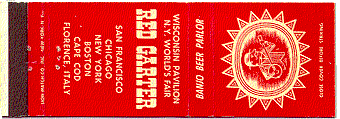
A souvenir of
the RED GARTER Banjo Beer Parlor at the Wiconsin Pavilion
Location proves fortunate
No other state had spent
less than $500,000 on their pavilion. When the lights were dimmed
on New York's "Billion Dollar Dream Fair" and the last
person had filed past "The World's Largest Cheese,"
13 million people had visited the Wisconsin Pavilion (according
to the New York Times of October 19, 1965). This placed
Wisconsin third among all state entries in attendance and eighth
among all exhibits at the Fair in popularity! Not bad for the
little pavilion that almost didn't make it to the Fair.
|